What Is a Dietary Supplement? The Legal Category That Explains Everything Else
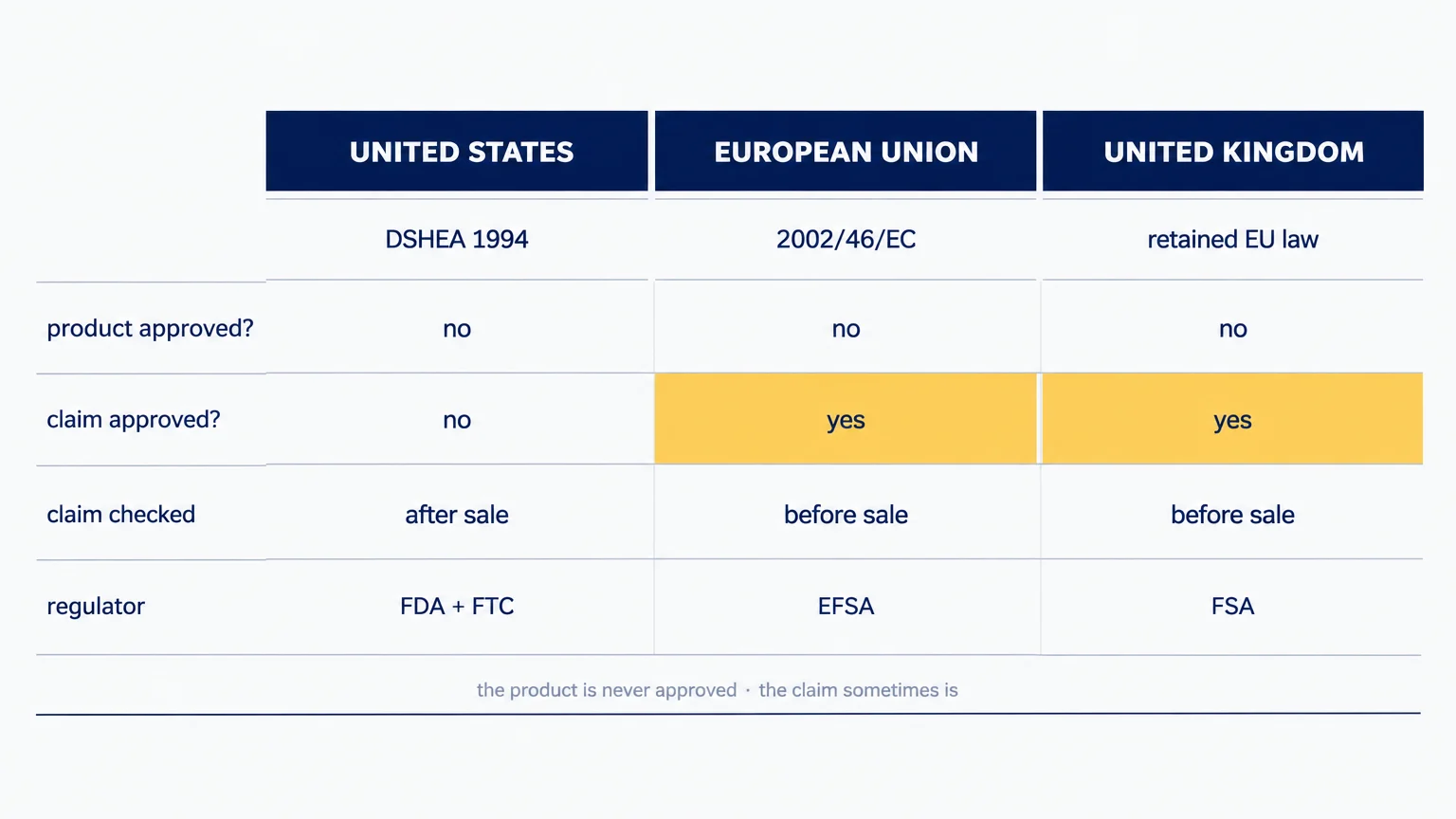
Three regulators, three different answers to one question: does anyone have to approve this before it is sold?
The short answer
A dietary supplement is a legal category of food, not a medicine without a prescription. That distinction is the single most useful fact in this entire subject, because everything else follows from it. Medicines must be proven safe and effective before anyone can sell them. Supplements, in the United States, do not have to be proven effective before sale at all.
The regulation that created this situation is DSHEA, passed in 1994. It placed the burden on the manufacturer to ensure safety and label accuracy, and on the regulator to act after a product reaches the market rather than before. The FDA does not approve supplements. It has never approved one, and it does not intend to.
This guide explains what that means concretely: what the law actually requires, what the label is and is not accountable for, why a claim about "supporting metabolism" is legal and a claim about treating a disease is not, and how the US regime differs from the EU and UK — where the product is still not pre-approved, but the claim is.
On this page
The previous six guides on this site each begin mid-argument. One explains how a blend hides its doses; another explains why a percentage cannot be verified; a third explains what a guarantee actually refunds. All of them depend on a piece of legal background that was never stated, and this guide states it.
The reason it matters is not academic. **If you know what a supplement legally is, most of the marketing behaviour in this category stops looking like dishonesty and starts looking like rational behaviour inside a very permissive system.** That is a more useful thing to understand, because it tells you where the weak points are and which claims are worth checking.
The legal definition
Under the Federal Food, Drug, and Cosmetic Act as amended by DSHEA, a dietary supplement is a product that meets all four of the following conditions:
- It is intended to supplement the diet — not to replace a meal or treat a condition.
- It contains a dietary ingredient: a vitamin, mineral, herb or other botanical, amino acid, a dietary substance used to increase total dietary intake, or a concentrate, metabolite, constituent, extract or combination of any of these.
- It is intended for ingestion in tablet, capsule, powder, softgel, gelcap or liquid form — not as a conventional food.
- It is required to be labelled as a dietary supplement, which in practice means carrying the Supplement Facts panel rather than the Nutrition Facts panel.
That fourth condition is the one you can verify yourself, and it is diagnostic. The Supplement Facts panel is the physical marker that the manufacturer has declared the product to be a supplement. It is not decoration and it is not a marketing choice: it is the document that places the product in this category and subjects it to this category's rules.
Because a supplement is legally a food, it is regulated on the food model: the manufacturer is responsible for safety and accuracy, and the regulator polices the market afterwards. Medicines are regulated on the drug model: premarket approval is required, and absence of approval means you cannot sell. Every weakness in supplement labelling that the earlier guides describe is a downstream consequence of that single choice.
DSHEA and what changed in 1994
Before 1994, the FDA had been moving toward treating supplements more like drugs. The Dietary Supplement Health and Education Act, signed in October 1994, reversed that direction and created the framework that is still in force.
DSHEA did four things, and each one has a visible trace on any label you pick up today:
| What DSHEA established | What you see as a result |
|---|---|
| Defined the category as a subset of food | The Supplement Facts panel instead of Nutrition Facts |
| Shifted the burden to the manufacturer for safety and labelling | No approval number anywhere on the package |
| Created structure-function claims with a mandatory disclaimer | The "not evaluated by the FDA" sentence at the bottom of the page |
| Required NDI notification for post-1994 ingredients | A 75-day filing that does not constitute approval |
The third row explains something the weight-loss claims guide treats at length. That disclaimer is not a company being unusually candid. It is a legal requirement, printed because the law demands it, and it happens to state accurately what the marketing above it is doing.
The second row is the one with the largest practical effect. **There is no approval number because there is no approval.** If you look at a supplement package expecting to find the equivalent of a drug's NDA number, you will not find one. What you find instead is a statement of the manufacturer's own responsibility, which is precisely what DSHEA assigned.
What "not FDA approved" actually means
The phrase "the FDA has not evaluated this statement" is often read as a warning. It is closer to a description of the system. Here is the honest version of how the two categories differ:
| Requirement | A new drug | A dietary supplement |
|---|---|---|
| Premarket approval | Required | Not required |
| Proof of efficacy before sale | Required — clinical trials | Not required |
| Proof of safety before sale | Required — preclinical and clinical | Manufacturer's own determination |
| Regulator reviews the dossier | Yes | No |
| Burden of proof | On the company, before sale | On the regulator, after sale |
| Response to a problem | Withdrawal from market | Warning letter, recall, or enforcement action |
The last row is the one that explains why recalls and warning letters happen at all. The FDA does have power over supplements — it can inspect facilities, require good manufacturing practice compliance, issue warning letters, seize products and pursue criminal action. What it does not do is review a product before it is sold.
This creates a specific asymmetry. **A supplement can be on sale for years before anyone establishes that it does not work, and by then the marketing has already done its job.** For a drug, the absence of approval is the end of the story. For a supplement, the absence of any evaluation is the beginning of it.
"Not FDA approved" does not mean "dangerous" and it does not mean "fraudulent". Most supplements are neither. It means that nobody has certified the benefit claim, so the claim rests on the manufacturer's own judgement. That is the specific thing to be sceptical about — not the safety of the product, but the basis of the promise.
New dietary ingredients
There is one partial exception to the no-approval rule, and it applies to ingredients rather than products.
If an ingredient was not marketed as a dietary supplement in the United States before 15 October 1994, the manufacturer must file a New Dietary Ingredient notification with the FDA at least 75 days before introducing it. The notification must contain evidence that the ingredient is reasonably expected to be safe under the conditions of use.
Two things about NDI notifications are worth knowing, because both are frequently misunderstood:
- A notification is not an approval. The manufacturer files; the FDA responds with a letter objecting or not objecting. An objection does not legally ban the ingredient, and the absence of objection is not a finding of safety.
- Filing is widely incomplete. Studies of the NDI regime have repeatedly found that a substantial share of products introduced after 1994 contain ingredients for which no valid notification was ever filed. This is a known enforcement gap, not a secret.
For a consumer, the practical consequence is narrow but real: **an exotic ingredient with an impressive name is not evidence of anything except that someone chose that name.** Whether it was ever notified is not printed on the label, and the label is not required to say.
Structure-function versus disease claims
This is the most consequential distinction in the entire category, and it is the one most often blurred by marketing.
| Structure-function claim | Disease claim | |
|---|---|---|
| What it describes | Effect on normal body function | Treating, preventing or curing a disease |
| Example | "Supports healthy metabolism" | "Treats metabolic syndrome" |
| Legal as a supplement? | Yes, with disclaimer | No — makes it an unapproved drug |
| Requires pre-clearance? | No | N/A — prohibited |
| Must be substantiated? | Yes, if challenged | — |
The boundary is not where most people assume. "Supports metabolism" is legal. "Supports weight loss" is legal, because weight is a normal body state rather than a disease. "Helps you lose 10 pounds in 30 days" is a quantified outcome claim and requires substantiation. "Cures obesity" is a disease claim and would make the product an unapproved drug.
Notice how much room sits between the first and the fourth. **That room is where most supplement marketing operates**, and it is why the wording of a claim is so carefully chosen. The vaguer the verb, the safer the claim — which is exactly the mechanic the previous guide describes as the "verb that measures nothing".
The required text runs: "This statement has not been evaluated by the Food and Drug Administration. This product is not intended to diagnose, treat, cure or prevent any disease." Read it as a legal description of what the product is not allowed to claim — and then compare it with the headline on the sales page. The distance between them is the amount of marketing latitude the law permits.
The FDA/FTC split
Here is a structural detail that explains a great deal about what you see online: in the United States, two different agencies regulate two different surfaces of the same product.
| Surface | Regulator | Standard |
|---|---|---|
| The label — Supplement Facts panel, ingredient list, warnings | FDA | Accurate as a condition of sale |
| The advertising — sales page, testimonials, percentages, social ads | FTC | Truthful, not misleading, substantiated |
The FDA regulates the physical product and its label. The FTC regulates advertising and marketing claims. Both standards are real, but they operate differently: **label compliance is checked at the point of sale, and advertising compliance is challenged after the fact.**
This is the structural reason the two surfaces can say different things. A claim that would be illegal on a Supplement Facts panel — an unsourced percentage, a testimonial implying a specific outcome, a before-and-after comparison — can appear in an advertisement, because advertising is judged retrospectively against a substantiation standard rather than cleared in advance.
Which brings us back to the central observation of this site's reviews. **The label and the sales page are governed by different rules, enforced by different agencies, on different timelines.** When they disagree, that disagreement is not necessarily illegal. It is the system working as designed.
Why the label is the only accountable document
Everything in this guide converges on one practical conclusion, and it is the conclusion that structures every review on this site.
The Supplement Facts panel is a legal declaration. It must be accurate as a condition of sale, and an inaccuracy in it is a violation the FDA can act on directly. A percentage on a sales page is a marketing statement that becomes actionable only if a regulator chooses to challenge it, and only after the fact.
Between the two, the panel is the document with consequences attached.
That is why the reviews published here are built from the panel rather than from the page, and why the site's method begins with the panel every time. It is not a matter of editorial preference. It is a matter of which document the manufacturer is legally answerable for.
The practical applications are direct:
- A published dose is a stronger fact than a published percentage. One is a legal declaration; the other is a claim awaiting a challenge that may never come.
- A proprietary blend is a legal choice that removes accountability. The blend guide explains why: the law permits a single total weight instead of individual amounts, so the panel discloses less without violating anything.
- A missing dose is not an omission the regulator will catch. It is permitted on many labels, which is why the comparison across markets matters — some regimes require more than others.
- The disclaimer is the seller's own statement of what it has not proven. It is required, it is accurate, and it is usually the last thing on the page.
The "clinically studied" guide and the price-per-day guide both rely on this. You cannot calculate a cost per milligram on a label that publishes no milligrams, and you cannot judge whether a dose reaches anything studied unless the dose is declared. Both methods depend on the panel being complete — which the law permits it not to be.
US vs EU vs UK
This is where the category becomes genuinely interesting, because the three regimes answer the same question differently — and the differences are visible to a consumer.
| United States | European Union | United Kingdom | |
|---|---|---|---|
| Legal basis | DSHEA 1994 | Directive 2002/46/EC | Retained EU law post-Brexit |
| Regulator | FDA (label), FTC (advertising) | EFSA (claims), Member States (market) | FSA and local authorities |
| Product pre-approved? | No | No | No |
| Health claim pre-approved? | No — substantiated after the fact | Yes — must be on the authorised register | Yes — retained register applies |
| Claims regulation | FTC substantiation standard | Regulation (EC) 1924/2006 | Assimilated 1924/2006 |
| Harmonised ingredient lists | No — NDI notification instead | Yes for vitamins and minerals | Retained lists |
| Typical visible effect | Bold claims; disclaimer at the bottom | Narrower claims; wording often dull | Closest to the EU model |
The row to read twice is health claim pre-approved. In the EU and the UK, a health claim must appear on an authorised register before it can be used, and the assessment is done by EFSA on the basis of generally accepted scientific evidence. In the US, no such clearance exists.
The consequence is directly observable. **European supplement marketing tends to use narrower, duller claims** — not because European companies are more honest, but because broader ones would be rejected before they could be printed. "Contributes to the maintenance of normal blood cholesterol levels" is the shape of an authorised claim: specific, modest, and boring. "Melts fat while you sleep" is not available in that system at all.
If you are reading a US-created sales page from the EU or UK, you are reading claims written for the least restrictive of the three regimes. The EU and UK registers exist precisely because those claims would not have been authorised there. That is worth knowing when a page addresses you in your own currency while using the language of a market that permits more.
There is one further difference worth stating. The EU harmonises which vitamins and minerals may be used in food supplements, which gives the category a defined boundary that the US regime does not have. In the US, the boundary is set by the manufacturer's own determination of whether an ingredient qualifies as a dietary ingredient at all — a judgement the NDI system partially polices, but only partially.
The consequence for buying
Five implications follow from everything above, and each one is checkable without a regulator.
- Judge the product by the panel, not the page. The panel is legally accountable and the page is retrospectively policed. Where they disagree, the panel is the document with consequences.
- Treat an absence of doses as an absence of information, not as an absence of risk. A blend is a legal choice that reveals less. You cannot price what you cannot see.
- Read the verb in every claim. "Supports" and "may help" are structure-function wording chosen because they are permissible, not because they are cautious. The claims guide sets out the four questions to apply.
- Check where the claim would have been written. A US page making claims that would not be authorised in the EU tells you which market the marketing was designed for, and not where you live.
- Read the guarantee as a contract, not a promise. The guarantee guide covers the clauses that decide what is actually refunded.
And one thing that does not follow. None of this means supplements are a scam or a category to avoid. Most contain real ingredients at real doses, and several have meaningful evidence behind them. **What it means is that the evidence has to be evaluated by you, because no agency is going to do it before the product reaches you.** That is the price of the category being regulated as food.
Frequently asked questions
Does the FDA approve dietary supplements before they are sold?
No. Under DSHEA, a supplement can be marketed without FDA premarket approval. The manufacturer is responsible for ensuring the product is safe and its labelling compliant, and the FDA acts after the product reaches the market. The partial exception is a new dietary ingredient not marketed in the US before 15 October 1994, which requires a notification at least 75 days before sale — but the FDA does not formally approve that notification.
Is a supplement a food or a medicine by law?
In the United States it is a category of food, defined separately in the Federal Food, Drug, and Cosmetic Act as amended by DSHEA. Its label follows food-panel conventions and its marketing follows food-claim rules rather than drug-approval rules. In the EU it is regulated as a foodstuff under Directive 2002/46/EC. This is the most important structural fact about the category: medicines must be proven to work before sale, and supplements do not.
What is a structure-function claim?
A statement describing how a nutrient or ingredient affects normal structure or function in the body — "supports metabolism", "helps maintain healthy bones". It does not describe treating, preventing or curing a disease, which would make the product a drug. Structure-function claims must be truthful, not misleading, and must carry the disclaimer that the statement has not been evaluated by the FDA. That disclaimer is why so many supplement pages end with a sentence contradicting their own marketing.
Do supplement companies have to prove their products work?
Not before selling. There is no efficacy pre-clearance for supplements. What the law requires is that advertising claims be truthful, not misleading, and substantiated by competent and reliable scientific evidence — a standard enforced by the FTC, and enforced after the claim is made rather than before. A company can launch a product with no efficacy data at all, and the burden materialises only if a regulator challenges the claim.
What is an NDI notification?
A New Dietary Ingredient notification. If an ingredient was not marketed as a dietary supplement in the US before 15 October 1994, the manufacturer must notify the FDA at least 75 days before introducing it, with evidence that it is reasonably expected to be safe under the conditions of use. The FDA responds with a letter but does not approve the ingredient. Many products contain ingredients for which no valid notification was ever filed — a known enforcement gap.
Who regulates supplement advertising if the FDA regulates the label?
The Federal Trade Commission handles advertising; the FDA handles labelling and safety. The split matters because most of what convinces a buyer — testimonials, percentages, before-and-after images, pricing bundles — appears in advertising, not on the label. A claim that would be illegal on a Supplement Facts panel can appear in an ad, and the FTC's standard applies retrospectively rather than as pre-clearance.
How does the EU regime differ from the US?
The EU harmonises which vitamins and minerals may be used in food supplements under Directive 2002/46/EC, and regulates health claims under Regulation (EC) No 1924/2006. That regulation requires health claims to be authorised following a scientific assessment by EFSA, based on generally accepted scientific evidence. So in the EU the claim is pre-cleared even though the product is not — the inverse of the US, where the product is freely marketed but any claim must be substantiated after the fact.
What happened in the UK after Brexit?
The UK retained the EU-derived health claims register as assimilated law and continues to apply it, with the Food Standards Agency and local authorities handling enforcement. Nutrition and health claims must still be on the authorised register to be used. The MHRA regulates medicines, including those containing vitamins or minerals at medicinal strengths, and the boundary between a food supplement and a medicinal product is decided case by case. The UK regime is closer to the EU than to the US.
If supplements are not approved, why does the label matter so much?
Because the label is the only document the manufacturer is legally accountable for. Advertising is subject to substantiation after the fact; the Supplement Facts panel must be accurate as a condition of sale. That is why a published dose is a stronger fact than any percentage on a sales page: one is a legal declaration that can trigger enforcement, and the other is a marketing statement that usually triggers nothing.
Does any of this mean supplements are unsafe?
No. Absence of premarket approval is not the same as absence of risk management. Many supplements are safe at labelled doses, and several ingredients have decades of use behind them. The regulatory gap is about evidence of benefit and accountability for claims, not an assumption that products are dangerous. The practical consequence is that safety and efficacy depend on what the manufacturer chose to do rather than on what a regulator required them to prove.
Closing
The most useful sentence in this subject is that a supplement is a food. Not a weak medicine, not an unregulated drug, not a scam category — a food with a legal definition, sold under the food model, where the manufacturer asserts safety and the regulator responds rather than approves.
Once that is clear, the six preceding guides stop being a list of complaints and become a description of consequences. A blend hides doses because the law permits a total instead of individual amounts. A percentage goes unsourced because no one cleared the claim before it was published. A guarantee is thin because no regulator specified it. A disclaimer contradicts the headline because the law requires the disclaimer and permits the headline.
What remains is not cynicism. It is a method. The panel is checkable, the doses are checkable, the arithmetic is checkable, and the refund terms are checkable. **Everything that can be verified, can be verified by you, in about the time it takes to read one page carefully.** Everything that cannot be verified — the percentages, the testimonials, the timelines — is legally permitted to be unverifiable, and that is exactly why it is on the page.
Read the label. It is the only part of the product that had to be true.
About this guide
BalancePhase publishes independent consumer research on supplement labelling and marketing. This guide contains no affiliate links and recommends no product. It was written and edited under the editorial direction of W. H. Neves, and the review method it supports is documented in our Methodology. Regulatory statements describe United States law as the primary framework, with comparison to the EU and UK; specific requirements change and should be confirmed with the relevant regulator. Nothing here is medical advice — consult a clinician about any supplement you are considering.
Sources
- U.S. Congress — Dietary Supplement Health and Education Act of 1994, Public Law 103-417, establishing the definition of a dietary supplement and the premarket notification regime for new dietary ingredients.
- U.S. Food and Drug Administration — 21 CFR Part 190, Dietary Supplements, including 21 CFR 190.6 on new dietary ingredient notification requirements.
- U.S. Food and Drug Administration — 21 CFR 101.36, Nutrition labeling of dietary supplements, establishing the Supplement Facts panel format and content requirements.
- U.S. Food and Drug Administration — 21 CFR 101.93, Certain types of statements for dietary supplements, on structure-function claims and the mandatory disclaimer.
- Federal Trade Commission — Dietary Supplements: An Advertising Guide for Industry, on the substantiation standard for advertising claims and the division of jurisdiction with the FDA.
- European Parliament and Council — Directive 2002/46/EC on the approximation of the laws of the Member States relating to food supplements.
- European Parliament and Council — Regulation (EC) No 1924/2006 on nutrition and health claims made on foods, and the EFSA scientific assessment process for claim authorisation.
- UK Food Standards Agency — guidance on nutrition and health claims for food supplements under retained EU law following the UK's withdrawal from the European Union.
Health disclaimer
This article is for information only and is not medical advice. It does not diagnose, treat or cure any condition and is not a substitute for consultation with a qualified healthcare professional.
Statements about dietary supplements have not been evaluated by the U.S. Food and Drug Administration. Regulatory information is provided for context and does not constitute legal advice. Requirements differ by jurisdiction and change over time. Individual results vary. If you are taking prescription medication or managing a diagnosed condition, speak to a clinician or pharmacist before adding any supplement.