Why "clinically studied" means almost nothing on a supplement label
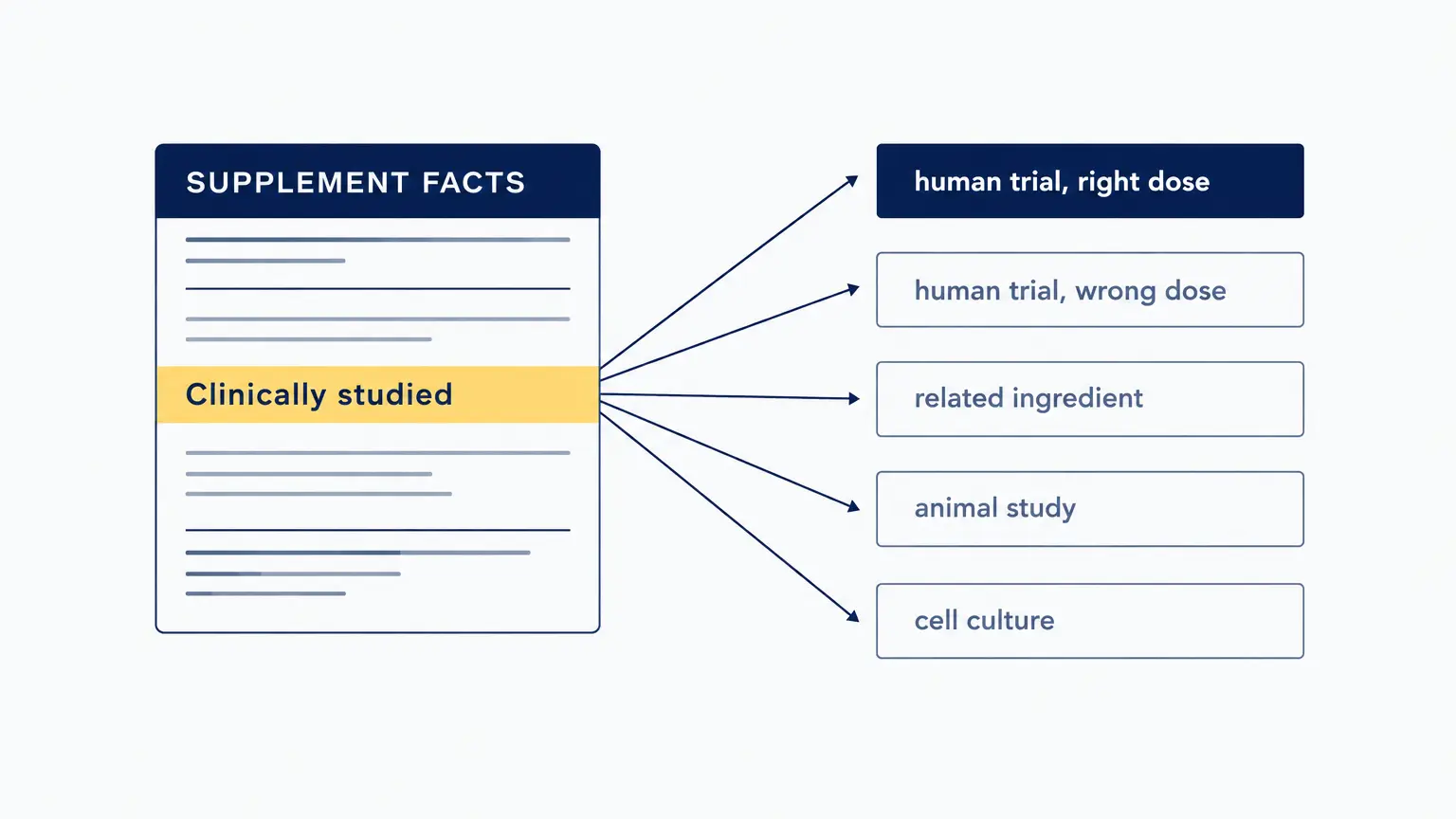
"Clinically studied" asserts that a study exists. "Clinically proven" asserts a result. Only one of them carries legal weight.
In one paragraph
"Clinically studied" has no legal definition. Neither the FDA nor the EU defines what the phrase must mean on a supplement label or sales page. It is not a health claim, so it does not need to sit on the EU register; it is not a disease claim, so it does not trigger drug regulation in the US. What applies is only the general prohibition on misleading advertising.
The consequence is that the phrase can truthfully describe at least five very different situations — from a well-designed human trial at the exact dose in the bottle, to a study of a different ingredient in a Petri dish. This guide separates them and gives you three questions to work out which one you are looking at.
On this page
There is a specific kind of frustration in reading supplement marketing. You are told something that is carefully true, in a way that leaves you knowing less than you did before. "Clinically studied" is the clearest example of the form: it is a sentence a company can write truthfully in almost any circumstance, and it is designed exactly for that.
This is not a story about a bad actor. It is a story about a phrase with no definition, used identically by companies with strong evidence and companies with none — which is precisely why it fails as a signal.
A phrase with no definition
Start with what the regulations actually say, because the answer is shorter than expected.
In the United States, the FDA regulates supplement labelling and the Federal Trade Commission regulates advertising. The FTC requires that objective product claims be supported by competent and reliable scientific evidence. That standard is real and enforced — but it is a standard about substantiation, not a definition of the specific words "clinically studied".
In the European Union, the picture is different in structure. Claims about an ingredient's effect on health must appear on the register of authorised health claims, with the authorised wording and the authorised conditions of use. That regime is strict. But "clinically studied" is not a health claim — it is a statement about the product's history of testing, so it falls entirely outside the register.
That gap is the whole mechanism. A phrase with no defined meaning cannot be violated, only abused — and abuse is much harder to prove, because there is no benchmark to measure against.
The five things it can mean
Every use of the phrase falls into one of these five categories. They are ordered from strongest to weakest evidence.
| # | What was actually studied | What the phrase conveys |
|---|---|---|
| 1 | This exact product, in humans, at this dose, on the claimed outcome, with a positive published result | The strongest version. The claim survives scrutiny |
| 2 | An ingredient in this product, in humans, at a comparable dose, on a related outcome | Legitimate but narrower — the evidence belongs to the ingredient, not the formula |
| 3 | An ingredient in this product, in humans, but at a much higher dose than the product delivers | The most common case. The study is real; the application is not |
| 4 | A related or similarly named ingredient, not the one in the bottle | The least defensible version that still avoids outright deception |
| 5 | Animal or cell-culture study, not a clinical trial in humans at all | "Clinical" stretches to cover a laboratory experiment |
Only the first two categories give the phrase real meaning. Rows three to five are where the phrase does its most effective work — because the underlying study genuinely exists, genuinely was published, and genuinely does not support the claim being made about the product in front of you.
Dose mismatch is not an edge case; it is the normal state of the category. A trial using 240 mg of an extract cannot be transferred to a product delivering 15 mg of it inside a blend. The citation is accurate. The inference from it is not. And because no regulation requires the two numbers to be compared, no one has to do it — except you.
Studied vs. proven
The distinction between these two words is the entire argument of this guide, compressed.
| Phrase | What it asserts | What it requires |
|---|---|---|
| "Clinically proven" | A result has been established | Evidence adequate to support an outcome claim — actionable if challenged |
| "Clinically studied" | A study exists | Demonstrably less. The existence of a study is far easier to establish than its conclusion |
| "Studies suggest" | Some research points in a direction | Something that can be cited, without asserting a finding |
| "Traditionally used" | A history of use exists | Nothing about evidence at all |
The move from "proven" to "studied" is a move from an assertion about results to an assertion about activity. "Clinically proven" invites the question "proven what?" and a company making it must be ready with an answer. "Clinically studied" invites no such question, because it already answered the only one it raised: yes, there was a study.
"Clinically studied" is a sentence about the past. "Clinically proven" is a sentence about the product. Only one of them can be wrong.
This is why the weaker phrase appears so much more often. It is not that the industry is avoiding a stronger claim it could make — it is that the stronger claim creates an obligation the phrase was designed to avoid.
The three-question test
You do not need to research the literature to cut through the phrase. Three questions take about a minute and eliminate most of the ambiguity.
- Was the study in humans? "Clinical" means involving patients or human participants. A cell-culture experiment or an animal study is not clinical in any ordinary sense, and using it to support the phrase is the weakest version of the claim. If the page cites a study, check the model organism or the cell line.
- Was the dose studied the dose in this product? Find the dose in the study abstract and the dose on the label. If they differ by more than a small margin, the evidence does not transfer. This question alone resolves most supplement claims.
- Was the result positive, published, and on the outcome being advertised? A study can exist and find nothing. A study can be registered and never reported. A study can measure a blood marker while the advertisement talks about how you feel. All three still make the phrase literally true.
When a sales page uses "clinically studied" without naming the study, the answer to all three questions is unknown — and unknown is the operative result. A company that had a positive human trial at the right dose would name it, because doing so sells. The absence of the citation is itself the information.
The full method for chasing down the evidence once you have the study name is set out in our guide on how to check whether a supplement claim is backed by evidence. This page is about the phrase; that one is about the search.
When the phrase is honest
It would be easy — and wrong — to read this guide as saying the phrase is always deceptive. It is not. There are legitimate uses, and they are recognisable.
- The product formulates at the studied dose. If the trial used 300 mg and the label delivers 300 mg, the phrase is straightforwardly true in the way a buyer would want it to be.
- The company names the study. A citation, a link, an author and a journal are all checkable. Vagueness is a choice, and specificity is the opposite choice.
- The claim is scoped to the ingredient. Saying "L-theanine has been clinically studied for relaxation" is honest even if the finished product has not been tested, because it does not imply otherwise.
- The evidence is presented without selectively hiding the negative. A company that mentions the trials that failed alongside the ones that succeeded is transmitting real information.
The distinguishing feature is not the phrase itself but what surrounds it. Honest use makes the underlying study findable. Dishonest use makes it a footnote with no reference.
What this guide does not do
This page contains no affiliate links and no product recommendations. It is part of the editorial side of BalancePhase, published to explain how a marketing phrase works rather than to sell anything. Where we apply the same analysis to a real product, the review states its sources and its limitations explicitly.
Its relatives: "doctor recommended" and "patented formula"
Three other phrases operate on the same principle — true statements that transmit almost no information. Recognising the family makes them easier to spot.
| Phrase | What it does not tell you |
|---|---|
| "Doctor recommended" | How many doctors, which specialties, in what context, or whether they recommended this product or its category. A small survey of a convenience sample can support the wording |
| "Patented formula" | Whether the formula works. Patents are granted for novelty and non-obviousness — not for efficacy. A patent can be issued for something that does not function as claimed |
| "Pharmaceutical-grade" | That any specific purity or testing standard was met. It has no formal regulatory meaning in this context |
| "Backed by science" | Which science, applied to what, at what dose, with what result. It is the broadest of the family and carries the least |
The pattern is consistent: each phrase names something real — doctors, patents, science — without specifying anything about the relationship between that thing and the product's performance. The name does the persuading; the missing specificity does the work of avoiding an actionable claim.
Reading a label that uses it
Four steps, in order:
- Check whether a study is named. No citation, no reference, no journal — treat the phrase as carrying zero information and move on.
- If a study is named, get the dose from it. Then get the dose from the label. If the label hides the dose inside a proprietary blend, the comparison is impossible, which is covered in our guide to proprietary blends.
- Check what the study measured. A symptom and a blood marker are different claims. If the study measured a marker and the page talks about how you feel, the phrase has been stretched.
- Notice what is missing. If there are three trials and only one is favourable, an honest page says so. A page that cites the favourable one and omits the rest is telling you which version of the phrase it is using.
None of this requires specialist knowledge. It requires ten minutes and the willingness to leave the sales page — which is the one thing the page is designed to prevent.
Frequently asked questions
Is "clinically studied" a regulated term?
No. Neither the FDA nor the EU has issued a formal definition of the phrase for supplement labels. What applies is the general prohibition on misleading advertising: the FTC Act in the United States and the Unfair Commercial Practices Directive in the EU both prohibit deception, but neither specifies what the phrase must mean. That absence is what makes it useful to sellers and unhelpful to buyers.
What is the difference between "clinically studied" and "clinically proven"?
The second is actionable. FTC guidance requires objective product claims to be supported by competent and reliable scientific evidence, and "proven" asserts an established outcome — so a company using it must be able to produce evidence adequate to that assertion. "Clinically studied" asserts only that a study exists, which requires far less. The first describes activity; the second claims results.
What does "clinically studied ingredient" actually mean?
It means an ingredient in the product has been the subject of at least one clinical study. It does not mean the study was in humans, on that finished product, at the dose in the bottle, or that it found anything. Any of those limitations can apply while the statement remains literally true.
Can a company use the phrase if the study failed?
In most cases yes, because the phrase describes the existence of study rather than its conclusion. A product whose ingredient was tested in a trial that found no significant difference from placebo has still been clinically studied. The inverse also holds: a product with no studies of its own can be marketed using a study of a related ingredient, provided the wording does not imply the study was of the finished product.
What are the three questions I should ask?
First: was the study in humans? A cell-culture or animal study is not clinical in the ordinary sense. Second: was it conducted at the dose the product delivers? Third: was the result positive, published, and on the outcome being claimed? If any answer is no or unknown, the phrase carries no weight for that product.
Is the phrase always dishonest?
No. A manufacturer that formulates at the studied dose and cites the specific trial is being accurate, and some products are genuinely supported by well-designed research. The problem is not the phrase itself but that it is used identically by companies with strong evidence and companies with none — so it cannot discriminate between them.
What about "doctor recommended" and "patented formula"?
They work the same way. "Doctor recommended" specifies neither how many doctors nor what they recommended; a small convenience survey can support the wording. "Patented formula" describes a legal protection for a composition, not a judgment about efficacy — patents are granted for novelty, not for results. Both are true statements that transmit almost no information about the product.
In the EU, is the phrase treated differently?
Partly. The EU operates a register of authorised health claims, so a specific claim about an ingredient's effect must use the authorised wording and conditions of use. That regime is strict. But "clinically studied" is not a health claim — it is a statement about the product's testing history — so it sits outside the register and remains undefined.
Should I avoid products that use the phrase?
Treat it as neutral rather than as a warning. It tells you nothing about whether the product works, in either direction. What it does indicate is that the company chose a statement with no defined meaning when a stronger one was available. If the study existed and was positive at the right dose, naming it would sell better — which makes its absence informative, though not conclusive.
About this guide
This is an editorial guide published by BalancePhase. It contains no affiliate links and no product recommendations. It was written and edited under the editorial direction of W. H. Neves, and the assessment method used across the site is documented in our Methodology. Regulatory references are to the Federal Trade Commission Act, FDA structure/function claim guidance, Directive 2002/46/EC, Regulation (EU) No 1169/2011 and Regulation (EC) No 1924/2006 on nutrition and health claims. Nothing here is medical advice.
Sources
- Federal Trade Commission Act, Section 5 — prohibition of unfair or deceptive acts or practices in commerce.
- U.S. Federal Trade Commission — Dietary Supplements: An Advertising Guide for Industry, on substantiation of objective product claims.
- U.S. Food and Drug Administration — Structure/Function Claims: Small Entity Compliance Guide.
- Dietary Supplement Health and Education Act of 1994 (DSHEA), Public Law 103-417.
- Regulation (EC) No 1924/2006 on nutrition and health claims made on foods, and the EU Register of authorised health claims maintained by the European Commission.
- Directive 2002/46/EC of the European Parliament and of the Council on food supplements.
- Directive 2005/29/EC on unfair business-to-consumer commercial practices (Unfair Commercial Practices Directive).
- Regulation (EU) No 1169/2011 on the provision of food information to consumers.
Health disclaimer
This guide is for information only and is not medical advice. It does not diagnose, treat or cure any condition and is not a substitute for consultation with a qualified healthcare professional.
Statements about dietary supplements have not been evaluated by the U.S. Food and Drug Administration or the European Medicines Agency. Individual results vary. Discuss any supplement with a clinician or pharmacist, particularly if you take prescription medication or have a diagnosed condition.