Price per day: the number sellers never put on the label
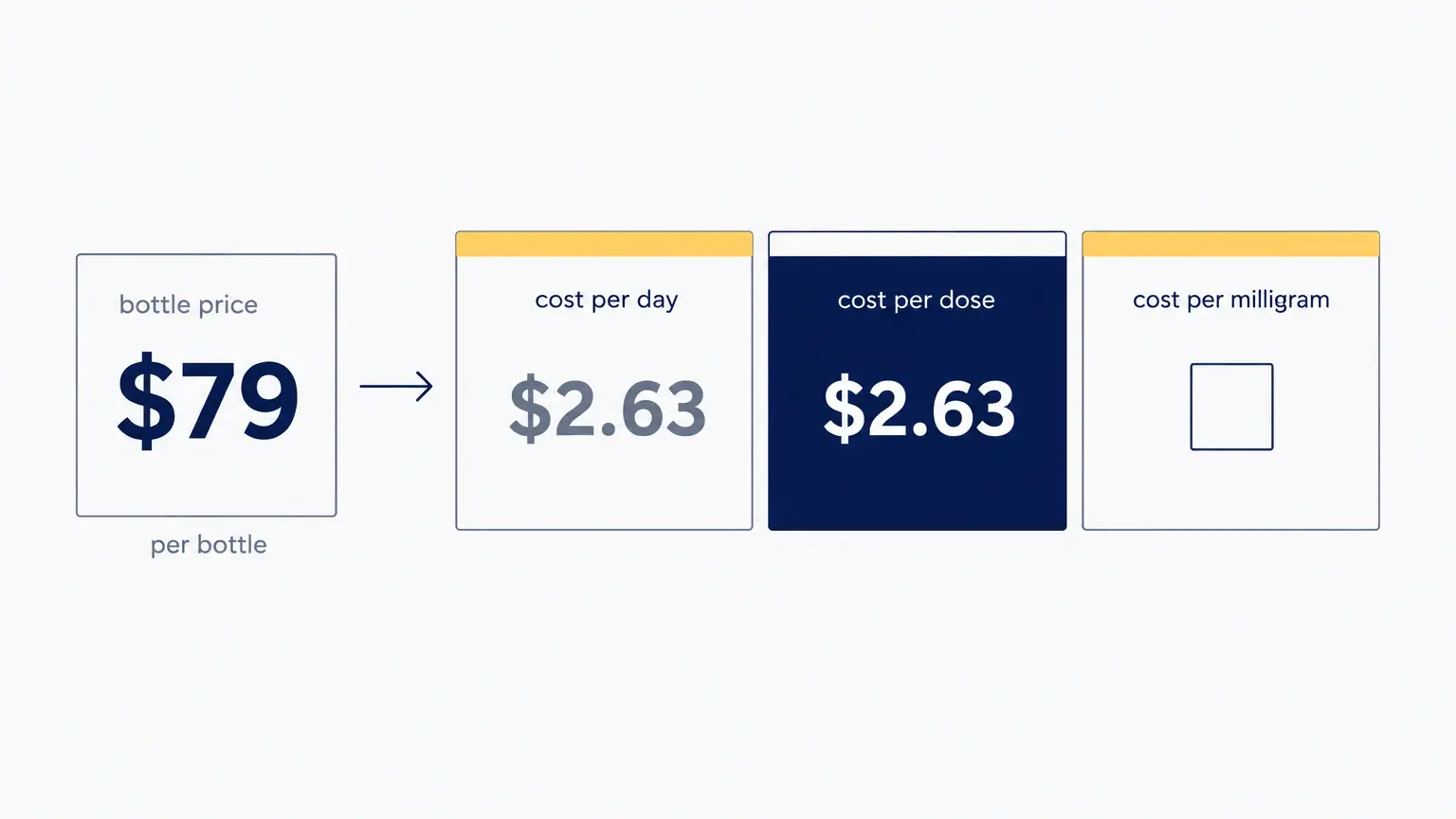
The bottle price is the number the seller controls. It is also the number that tells you least.
In one paragraph
Two supplements advertised at the same price per bottle can differ by a factor of four in what they cost you per day, because bottles contain different amounts and serving sizes differ. The honest comparison requires three figures, none of which appears on a sales page: cost per day, cost per dose and cost per milligram.
This guide explains how to calculate each one, why the large-package discount is designed to look like a product price when it is not, how shipping quietly changes the ranking between two products, and the point at which a pricing comparison stops being possible at all. It is arithmetic, not opinion — and it takes about four minutes per product.
On this page
Buying a supplement is one of the few purchases where the advertised price is routinely calculated on a unit that does not correspond to how the product is used. Petrol is priced by the litre, bread by the loaf, and a supplement by a bottle that might last three weeks or three months depending on a serving size printed somewhere else on the page.
The consequence is that two people can say "it costs about fifty dollars" about two products whose real cost differs by hundreds of dollars a year. Both statements are true. Only one of them is useful.
Why the bottle price is the wrong number
Three variables sit between the advertised price and what you actually spend. None of them is hidden, and none is stated where the price is.
| Variable | What it changes | Where to find it |
|---|---|---|
| Serving size | How many days one container lasts | Supplement Facts panel, top row |
| Servings per container | The multiplier that turns capsules into days | Supplement Facts panel, second row |
| Package size | The per-bottle rate and whether shipping applies | Checkout page, not the headline price |
A capsule product declaring a serving of two capsules from a 60-capsule bottle is a thirty-day supply. The same 60-capsule bottle declaring a serving of one capsule is a sixty-day supply. Identical bottle, identical price, half the cost per day. Nothing about the bottle tells you which you have.
Liquids make this worse, because the serving is a volume rather than a count. A 30 ml dropper bottle at a 1 ml serving is thirty days. At a 0.5 ml serving it is sixty. The millilitre figure is printed, but it is printed on the panel, while the price is printed in the largest type on the page.
Before reading any price, open the Supplement Facts panel and note two numbers: the serving size and the servings per container. Everything else in this guide depends on them.
The three numbers that matter
Each answers a different question, and each is useful in a different situation. In order of how often you need them.
1. Cost per day
This is the figure that compares across products, brands and package sizes. It is the only number that tells you what the habit costs you over a year. If a product costs $1.63 per day, that is roughly $595 annually; at $2.63 per day it is roughly $960. Neither figure appears anywhere on the checkout.
2. Cost per dose
This is where crowded formulas reveal themselves. A product carrying eighteen active ingredients at $1.63 per day is spending roughly nine cents per ingredient per day. A product carrying two actives at the same cost per day is spending eighty cents each. The first is not cheaper; it is the same money spread thinner.
The measure is imperfect, because ingredients are not equally valuable and a formula may concentrate its weight on one or two. But as a first read on whether a long ingredient list represents depth or dispersal, it is quick and it is honest.
3. Cost per milligram
This is the most precise figure and the one that most often cannot be calculated. When a label states the individual dose of an ingredient, you can work out what a researched quantity costs. When it states only a blend total, you get a ceiling rather than a figure — the cost divided by the total blend weight, divided across however many ingredients are inside it, tells you the most any one ingredient could be contributing.
That ceiling is still useful. If the ceiling falls below the dose used in clinical trials, the product cannot be delivering a studied dose, and no further pricing analysis is required.
Cost per milligram is where price and label meet. A product can be the cheapest per day and the most expensive per milligram of useful ingredient at the same time — that is exactly what a low-cost, heavily diluted formula is. The guide to proprietary blends explains how to establish that ceiling from a blend total.
The bundle anchor
Almost every supplement checkout shows three packages: a small one, a middle one marked "most popular", and a large one marked "best value". The large package carries the lowest per-bottle rate, and that rate is presented as though it were the product's price.
It is not. It is the price of a six-month commitment, and the smaller packages are priced higher precisely so the large one looks like the obvious choice.
| What the checkout implies | What is actually true |
|---|---|
| "$49 per bottle" | $49 per bottle on a 180-day order |
| "Best value" | Best rate per bottle; largest cash outlay; longest commitment |
| "You save $900" | Saving measured against a list price nobody pays |
| "Most popular" | A statement about other buyers, not about what fits you |
The saving figure deserves particular attention. A discount of sixty or seventy percent against a "regular" price is common in this category, and the regular price is frequently a number that has never been charged. The guarantee guide describes how the same promotional structure interacts with the return window; the point here is narrower — a discount is only meaningful if the reference price is real.
The lowest per-bottle rate is not the product's price. It is the price of committing for six months to a product you have not tried.
There is a genuine case for the large package: cost per day falls, and if you have already used the product and intend to continue, buying the cheaper unit is rational. The error is treating the largest package's rate as the entry price when deciding whether to try something at all.
Shipping is part of the price
Many checkouts apply shipping to the smaller packages and waive it on the largest. That has two effects, and both push in the same direction.
First, the effective cost per day of the small package is higher than its headline suggests — often by ten to twenty percent, which is enough to reverse a comparison against a competitor that builds shipping into the price. Second, the discount on the large package is larger than the advertised per-bottle difference, because the comparison now includes a delivery charge you would otherwise pay.
Landed cost: price plus shipping plus any tax or handling. Not the per-bottle rate, not the subtotal. On a two-bottle order with paid shipping, a $79 per-bottle rate can land at $85 or more per bottle once delivery is divided across the units.
For international buyers there is a third component that is rarely accounted for: import duties and handling fees collected by the carrier. These frequently exceed the shipping charge itself, and they are not part of the seller's advertised price at all.
Two worked examples
Both figures below use structures that are common in the category. No product is named, and the numbers are illustrative of the arithmetic rather than of any particular seller.
Example A — capsules
A product declares a serving of two capsules, 60 capsules per bottle, priced at $79 per bottle with shipping of $9.99 on a two-bottle order.
| Step | Calculation | Result |
|---|---|---|
| Days per bottle | 60 capsules ÷ 2 per day | 30 days |
| Total paid | $158 + $9.99 shipping | $167.99 |
| Cost per day | $167.99 ÷ 60 days | ≈ $2.80 |
| Headline implies | $79 ÷ 30 | $2.63 — understates by 6% |
Now the same product on the largest package: six bottles at $49 with free shipping. Total $294, 180 days, cost per day $1.63. The difference between $2.80 and $1.63 is not a discount on the product — it is the price of the commitment, plus the shipping you no longer pay.
Example B — liquid
A product declares a serving of 1 ml in a 30 ml bottle, priced at $59 per bottle on a three-bottle order with free shipping.
| Step | Calculation | Result |
|---|---|---|
| Days per bottle | 30 ml ÷ 1 ml per serving | 30 days |
| Total paid | $177, free shipping | $177.00 |
| Cost per day | $177 ÷ 90 days | ≈ $1.97 |
| Cost per active | $1.97 ÷ 22 ingredients | ≈ $0.09 per ingredient per day |
Example B is cheaper per day than Example A. It is also the thinner formula: at roughly nine cents per ingredient per day, and with the doses unpublished, the cost per milligram of any single active ingredient cannot be established at all. The cheaper product is not the better buy — it is the cheaper way to buy less.
When the comparison becomes impossible
There is a point at which a pricing comparison stops being difficult and becomes meaningless, and it is worth naming it plainly because sales copy rarely does.
Cost per milligram requires a milligram figure. If the label states individual doses, the arithmetic works. If the label states a single blend total, you can compute a ceiling but not a figure. If the label states no amounts at all, there is nothing to divide — not even a ceiling.
| Label states | What you can calculate | Comparison possible? |
|---|---|---|
| Individual doses | Cost per milligram exactly | Yes — fully |
| Blend total | Cost per milligram ceiling | Yes — as an upper bound |
| No amounts | Nothing | No |
A product in the third row can still be compared on cost per day, but that comparison answers a trivial question: which bottle costs less. It says nothing about value, because value requires knowing what is inside the bottle.
When a label publishes no doses, pricing analysis should stop rather than proceed on cost per day alone. Continuing produces a confident-looking table that compares prices without comparing anything that matters.
A five-step method
Applies to any supplement, and takes about four minutes per product once you have done it twice.
- Find the serving size and servings per container. Top of the Supplement Facts panel. Without these two numbers nothing else works.
- Convert to days of supply. Capsules: count ÷ capsules per serving. Liquids: volume ÷ serving volume. Powders: scoops per container ÷ scoops per day.
- Calculate landed cost. Price plus shipping plus tax, for the specific package you are considering — not the largest one, unless you are actually going to buy it.
- Divide, then divide again. Landed cost ÷ days of supply gives cost per day. That figure ÷ number of active ingredients gives cost per dose. If the label publishes a dose for the ingredient you care about, divide the cost per day by that milligram figure to get cost per milligram.
- Apply the ceiling test. Where only a blend total exists, calculate the maximum any single ingredient could contribute and compare that ceiling to the dose used in research. If the ceiling falls short, the product cannot reach a studied dose regardless of price.
Write the three figures down before comparing two products. Doing it from memory a week apart is how people end up comparing a cost per day against a per-bottle rate without noticing.
Six checks before you compare
Frequently asked questions
Why is the bottle price not a useful comparison?
Because bottles contain different amounts and serving sizes differ. A 120-capsule bottle taken four times a day lasts thirty days; a 60-capsule bottle taken once a day lasts sixty. The same bottle price can represent half or double the duration. Cost per day normalises for both.
How do I calculate cost per day?
Divide the total amount paid, shipping included, by the number of days the package lasts. For capsules, divide the count by capsules per day. For liquids, divide the volume by the serving volume. Always use the total paid rather than the per-bottle headline.
What is cost per dose and why does it matter more?
It is the cost per day divided by the number of active ingredients. A product with eighteen actives costs the same per day as one with two, but far less per active. This is where crowded formulas reveal their economics — spreading the same spend across more actives means each receives less.
What is cost per milligram and when can I use it?
It is the price divided by the milligrams of the ingredient you care about, and it is only calculable when the label publishes that dose. With a blend total you can calculate a ceiling, not a figure. With no amounts at all, nothing can be calculated.
Why do larger packages look so much cheaper?
Because the advertised per-bottle rate for the large package is the best rate the seller offers, displayed as though it were the product's price. The lowest figure is available only with the largest commitment, and the smaller packages are priced higher so the large one looks obvious.
Does shipping really change the comparison?
Often enough to matter. On a two-bottle order with paid shipping, effective cost per day can be ten to twenty percent above the headline — enough to reverse a comparison against a competitor that includes shipping in its price. Use landed cost.
Is the cheapest cost per day the best product?
Not necessarily. A low cost per day applied to an underdosed formula means you pay little for very little. The useful comparison is cost per day against cost per effective dose. A cheaper product that cannot deliver a studied dose is not the better buy; it is the cheaper way to buy less.
What about subscription pricing?
It is usually the lowest available rate, but it changes the commitment rather than the arithmetic. Calculate the annualised cost, not the per-shipment cost, and read how cancellation works before enrolling. A subscription that is hard to cancel has a cost that does not appear in the price.
Do loyalty points or bonus items count?
Only if you would have bought them anyway. A free e-book or bonus guide is frequently a marketing asset valued by the seller rather than by you, and pricing it into the product's value inflates the comparison. Calculate cost per day on the product alone.
How this guide is used elsewhere on the site
Every review on this site applies this arithmetic before drawing a conclusion, and states the cost per day for each package rather than repeating the per-bottle rate. Where a label publishes no doses, the review says the cost per milligram cannot be calculated instead of substituting a figure.
About this guide
This is an editorial guide published by BalancePhase. It contains no affiliate links and names no product. It was written and edited under the editorial direction of W. H. Neves, and the assessment method used across the site is documented in our Methodology. The worked examples use structures common in the category and are illustrative of the arithmetic, not of any particular seller's pricing. Nothing here is financial or medical advice.
Sources
- U.S. Food and Drug Administration — 21 CFR 101.36, Nutrition labeling of dietary supplements, including serving size and servings per container requirements.
- Federal Trade Commission — Guides Against Deceptive Pricing (16 CFR Part 233), on the use of fictitious or former prices in comparative advertising.
- Directive 98/6/EC of the European Parliament and of the Council on consumer protection in the indication of prices of products offered to consumers, including unit price requirements.
- The Consumer Protection from Unfair Trading Practices Regulations 2008 (United Kingdom), on misleading price indications.
- Directive 2005/29/EC on unfair business-to-consumer commercial practices, Annex I, on price reduction announcements and reference price requirements.
Health disclaimer
This guide is for information only and is not medical or financial advice. It does not diagnose, treat or cure any condition and is not a substitute for consultation with a qualified professional.
Statements about dietary supplements have not been evaluated by the U.S. Food and Drug Administration or the European Medicines Agency. Individual results vary, and price is not an indicator of efficacy. Discuss any supplement with a clinician or pharmacist, particularly if you take prescription medication or have a diagnosed condition.