ColestZen Review: 18 ingredients named, zero doses published
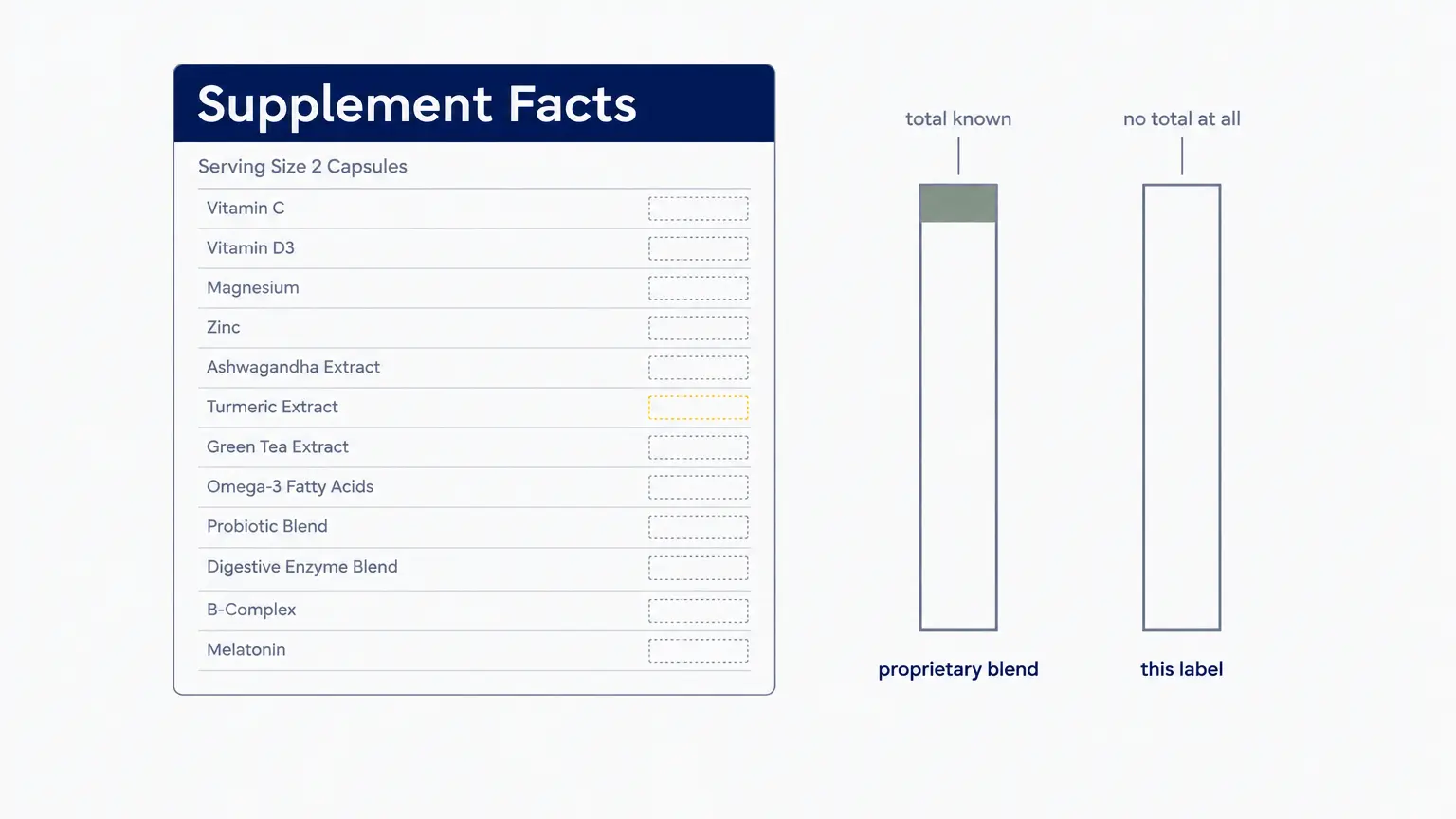
Eighteen names, no numbers. The manufacturer says so plainly on its own product page.
In one paragraph
ColestZen names all 18 of its ingredients and publishes the quantity of none of them. The manufacturer states this openly: "Exact per-ingredient amounts are not published on the current product label." There is no proprietary blend hiding the numbers, no total weight — simply no amounts at all. That is a different problem from the one our proprietary blends guide describes, and it produces the same result for you: you cannot tell whether any ingredient is present at a dose that research supports.
What the product does well is real. The claims stay inside structure/function territory instead of promising to treat a diagnosis. The ingredient names are published rather than buried. The checkout is a recognised processor with a 60-day return window. This review documents all of that, and then explains why none of it substitutes for a number.
On this page
Cholesterol supplements attract a particular kind of marketing. The category sells to people who have just seen a blood test result they did not like, which means it sells to fear, and fear tolerates vagueness better than almost any other buying motive.
ColestZen is better than most of its category on one axis and structurally limited on another. Both parts are worth being precise about.
What the label lets you check
Start with what is actually verifiable, because it is more than the average product in this space offers.
Three checks pass, three do not. The pattern is worth noticing: everything that can be verified without a laboratory has been published, and everything that requires a measurement has not.
The dosing question
This is the centre of the review, so it deserves its own passage rather than a table row.
On its own website, ColestZen's manufacturer writes, in plain English:
"Exact per-ingredient amounts are not published on the current product label — check the bottle you receive for the most current information."
And in the ingredient table that follows, the point is repeated ingredient by ingredient. Cinnamon: "amount and extract form not disclosed on label." Banaba: "standardization and amount not published." L-Taurine: "effect depends on dosage, which is not published." Magnesium: "form and elemental amount not published."
The same page also states, under a heading about disclosure, that "all 18 ingredients are named on the label — no proprietary blend hiding what's inside."
Both statements are true. They are also not the same claim, and the distance between them is the entire review.
| Situation | What you know | Can you compare to a studied dose? |
|---|---|---|
| Proprietary blend | Names and a combined weight | No — but you know the ceiling |
| ColestZen | Names only | No — and you do not know the ceiling |
| Full disclosure | Names and individual amounts | Yes |
A proprietary blend is the familiar problem, and our guide to proprietary blends explains how to work out what it hides. ColestZen's structure is a variant that is, in one narrow sense, harder to reason about: with a blend you can at least divide the stated total by the number of ingredients and establish an upper bound. Here there is no total to divide.
"No proprietary blend" is not the same sentence as "doses disclosed". It means the numbers are hidden differently.
That distinction has a practical consequence. A dose you cannot see cannot be compared against the dose used in a clinical trial — which is the third question in the three-question test set out in our guide to "clinically studied". Every ingredient in this formula fails that question, not because the evidence is absent, but because the product does not tell you enough to apply it.
The 18 ingredients, read properly
The formula splits into two halves. Read below what each half is actually for, and where the dosing question bites hardest.
The nine botanicals
| Ingredient | What it is normally studied for | Where the doubt sits |
|---|---|---|
| Bitter melon | Glucose metabolism | Studied mostly in diabetes contexts, at gram-level doses |
| Cinnamon bark | Glucose and lipid markers | Effect varies enormously by species and extract; neither is stated |
| Licorice root | Traditional digestive use | Contains glycyrrhizin — relevant to blood pressure, with no amount disclosed |
| Gymnema sylvestre | Glucose absorption | Studied at extract doses; leaf powder and extract are not interchangeable |
| Banaba leaf | Glucose metabolism | Standardisation (corosolic acid) is the active variable, and it is not published |
| Mulberry fruit | Glucose metabolism | Fruit powder is a food ingredient; studied extracts differ |
| Yarrow | Traditional circulation use | Little modern human trial data at any dose |
| Cayenne pepper | Circulation, thermogenesis | Active compound is capsaicin; extract strength is unstated |
| Juniper berry | Traditional general use | No meaningful human data for the claims implied |
The nine micronutrients
L-taurine, alpha lipoic acid, vitamin C, vitamin E, biotin, magnesium, zinc, manganese and chromium. Individually these are ordinary and unremarkable — and for a buyer, this half of the formula raises a different question than the botanical half.
Vitamins and minerals in a multivitamin-style panel are close to commodity ingredients. Vitamin C is vitamin C. The question is not whether it works; it is whether the product duplicates what you already take. With no amounts published, that question cannot be answered either — you cannot tell whether this adds meaningfully to your existing intake or tips you past a tolerable upper limit.
Several botanicals here — bitter melon, gymnema, banaba — plus chromium all act on glucose metabolism. Stacking four glucose-active ingredients is a formulation choice, not a neutral one, and the combined effect has not been studied. If you take medication for blood sugar, this combination is a reason for a conversation with a clinician rather than a reason to guess. The manufacturer's own page says as much in its caution column.
What the evidence supports
The honest answer is: the ingredients are plausible, and the product's use of them cannot be evaluated.
That is not cynicism. Take the strongest case in the formula. Cinnamon has randomised trial data on fasting glucose and lipid markers. Berberine — not in this formula, but the reference point in this category — has a substantial literature. Chromium has a small and inconsistent one. Mulberry leaf extract has real trials. The underlying ingredients are not fantasy.
But every one of those findings is dose-specific. A trial using 1 g of cinnamon bark powder tells you nothing about a formula that may contain 50 mg of it, and the label gives you no way to tell which you have. Likewise for gymnema and banaba, where the active variable is extract standardisation rather than raw weight.
If you want the method for checking any ingredient claim yourself, the evidence guide sets out five databases and a five-step process. You can run every one of the 18 names through it. What you cannot do is close the loop, because the loop requires a number.
Price per day
The checkout offers three packages. The number that matters is not the per-bottle price — it is the daily cost, which is the only figure that compares across products.
| Package | Per bottle | Total | Shipping | Per day |
|---|---|---|---|---|
| 2 bottles (60 days) | $79 | $158 | Added | ≈ $2.63 |
| 3 bottles (90 days) | $69 | $207 | Added | ≈ $2.30 |
| 6 bottles (180 days) | $49 | $294 | Free US | ≈ $1.63 |
A bottle holds 60 capsules, taken two per day — a 30-day supply. Two things about this pricing deserve attention.
First, the discount structure is aggressive: the 6-bottle rate is 38% below the 2-bottle rate, and the checkout states that 96% of customers choose it. That is a familiar pattern in this category, and it front-loads a decision — six months of an unverifiable formula, bought before you have taken a single capsule.
Second, the 2- and 3-bottle packages add shipping, which changes the effective daily cost upward in a way the headline per-bottle price conceals. At $79 plus shipping, the real cost per day is closer to $2.80–$3.00 depending on destination.
The 60-day guarantee
The published terms state that a buyer who is not satisfied can contact the seller within 60 days for a full refund. That is a genuine return window and longer than many competitors offer.
It is also worth reading the way all guarantees should be read, which we set out in full in our guide to supplement guarantees. The four points that decide what a window is actually worth:
- When the 60 days start. Guarantees in this category typically count from the purchase date, not delivery. On a multi-bottle order shipped internationally, that can consume two weeks of the window before the first capsule is taken.
- What is refunded. The product price is the standard scope; original shipping is commonly excluded. On the 2- and 3-bottle packages that shipping is a real fraction of what you paid.
- Whether the product must be returned. If a physical return is required and postage is the buyer's, the net recovery is lower than the headline refund.
- How long the refund takes. Approval and payment are separate events.
None of this makes the guarantee worthless. It makes it ordinary. A 60-day window at this package structure is a conversion instrument operating exactly as designed — which is a fair thing for a seller to do, and a thing a buyer should understand before weighing it as reassurance.
If a dispute arises and the refund process fails, the card issuer is the practical route. A chargeback operates on card network rules with a defined dispute window — commonly around 120 days from the transaction. Keep a screenshot of the guarantee as it was published on the day you bought.
What the ratings are worth
The official site displays a rating of roughly 4.9 out of 5 across more than twelve thousand buyer ratings, and several testimonials describing cholesterol reductions of 35 to 42 points.
Those numbers should be read with three facts in mind.
The ratings are collected and published by the seller. They are not an independent survey and not a controlled measurement. There is no way to know how many buyers were invited, how many declined, or what proportion of dissatisfied customers asked for a refund instead of leaving a review — which is the group whose opinion would matter most.
Testimonials describing a specific numerical change are the least reliable form of evidence in the category. A drop of 40 points in LDL is a large clinical effect. It is achievable through diet, through a new prescription, through the natural variability of a single measurement, or through the placebo effect — and a testimonial cannot distinguish between them. Lipid values also fluctuate between tests in the same person without any intervention.
Ratings measure satisfaction, not efficacy. Those are different questions. A product can make people feel they are taking action on a problem and score highly while producing no measurable change in any marker.
None of this means the ratings are fabricated. It means they cannot do the work that would settle the question — and the question they cannot settle is the one this review is about.
Who should not buy
This section exists in every honest review and is avoided in most commercial ones. ColestZen is not for you if any of the following applies.
- You have a diagnosed lipid disorder and a prescription. This product is positioned as support. It is not a substitute for a statin, and substituting one for the other is the single most dangerous outcome in this category.
- You take medication for blood sugar. The formula stacks four glucose-active ingredients plus chromium, at unpublished doses. That combination has not been studied, and the interaction risk is real.
- You take blood thinners or face surgery. The formula includes vitamin E. Discuss it with a clinician before starting, and stop before a procedure.
- You have high blood pressure and are considering long-term use. Licorice root contains glycyrrhizin, which can raise blood pressure — and with no amount stated, you cannot assess your exposure.
- You are pregnant or nursing, or under 18. No published safety data supports use, and the manufacturer's own materials exclude these groups.
- You will not take it consistently. Every ingredient in this formula that has evidence sits in a supplement category where effects, when they appear at all, take weeks. Six bottles is six months.
Verdict
ColestZen is a real product from an identifiable seller, positioned honestly within supplement regulation, with a formula whose individual ingredients have plausible literature behind them. It is not a scam, and nothing in this review suggests otherwise.
What it is, more precisely, is a formula you cannot evaluate. Eighteen names, no quantities, no extract specifications, no published testing. The manufacturer states this openly. The consequence is that the decision to buy rests entirely on the seller's account of the product rather than on any figure you can check — and that is the one thing a review exists to point out.
At a glance
The reasonable conclusion: if you want a fully disclosed formula, this is not one, and no amount of favourable testimonials changes that. If you are going to try it regardless, buy the smallest package that gives the product a fair trial, subtract the shipping from your calculation, note the guarantee terms as they stood on the day you bought, and check your lipid panel with your doctor rather than with the product's testimonial page.
The manufacturer publishes the full ingredient list, current pricing and guarantee terms on its official site.
Check current ColestZen pricing →Affiliate link · We may earn a commission at no extra cost to you
Frequently asked questions
Does ColestZen publish the dose of each ingredient?
No. The manufacturer states on the official product page that exact per-ingredient amounts are not published on the current product label. The names are published; the quantities are not. This differs from a proprietary blend — there is no stated total weight — but produces the same outcome: no dose can be compared against a studied dose.
Is ColestZen a proprietary blend?
Not in the technical sense. A proprietary blend discloses a combined weight while hiding individual amounts, which 21 CFR 101.36 permits. ColestZen names its ingredients separately and states no amounts at all. The distinction matters legally, not practically.
Can I verify the claims without doses?
Only in part. You can verify that each named ingredient has published literature and a known effective dose range. You cannot verify whether the product reaches that range — so the claim can be neither confirmed nor refuted from the label.
What does the 60-day guarantee cover?
The published terms offer a full refund on request within 60 days. Read the details: the window is generally counted from purchase rather than delivery, shipping is commonly excluded, and a required physical return at your cost reduces the net recovery. Confirm the terms in force when you buy.
What is the cost per day?
Approximately $1.63 at the 6-bottle rate of $49 per bottle, and approximately $2.63 at the 2-bottle rate of $79. The 6-bottle package ships free in the US; the others add shipping on top.
Who should not buy it?
Anyone with a diagnosed lipid disorder on prescribed medication, anyone taking glucose-lowering drugs, anyone on blood thinners or approaching surgery, anyone with high blood pressure considering long-term use (licorice root), anyone pregnant or nursing, and anyone under 18.
Do the customer ratings prove it works?
No. They are collected and published by the seller, are not independently verified, and cannot separate the product's effect from diet, medication changes or expectation. They record satisfaction claims, not efficacy.
Is ColestZen a scam?
Nothing indicates fraud. The product exists, the seller is identifiable, the ingredient names are published, the checkout is a recognised processor, and the claims stay within structure/function territory. The criticism here concerns verifiability, not honesty.
About this review
Written and edited by W. H. Neves under the standards set out in our Methodology and Editorial Policy. The analysis is based on the manufacturer's own published product page, the current checkout terms, and the regulatory framework described in 21 CFR 101.36 and DSHEA. This page contains affiliate links; see the Affiliate Disclosure. Nothing here is medical advice.
Sources
- ColestZen official product page — ingredient list, published statement that exact per-ingredient amounts are not disclosed, and current pricing. Accessed 13 November 2026.
- U.S. Food and Drug Administration — 21 CFR 101.36, Nutrition labeling of dietary supplements, including proprietary blend provisions.
- U.S. Food and Drug Administration — Structure/Function Claims: Small Entity Compliance Guide.
- Dietary Supplement Health and Education Act of 1994 (DSHEA), Public Law 103-417.
- Federal Trade Commission — Dietary Supplements: An Advertising Guide for Industry, on substantiation of objective product claims.
- NIH Office of Dietary Supplements — fact sheets on chromium, magnesium, vitamin E and zinc.
- Published randomised trial literature on cinnamon, gymnema sylvestre, banaba leaf extract and mulberry leaf extract, reviewed for dose ranges; individual citations available on request.
Health disclaimer
This review is for information only and is not medical advice. It does not diagnose, treat or cure any condition and is not a substitute for consultation with a qualified healthcare professional.
Statements about dietary supplements have not been evaluated by the U.S. Food and Drug Administration. This product is not intended to diagnose, treat, cure or prevent any disease. Individual results vary. Discuss any supplement with a clinician or pharmacist, particularly if you take prescription medication or have a diagnosed condition.