The 92% Claim: How Supplement Marketing Manufactures a Statistic
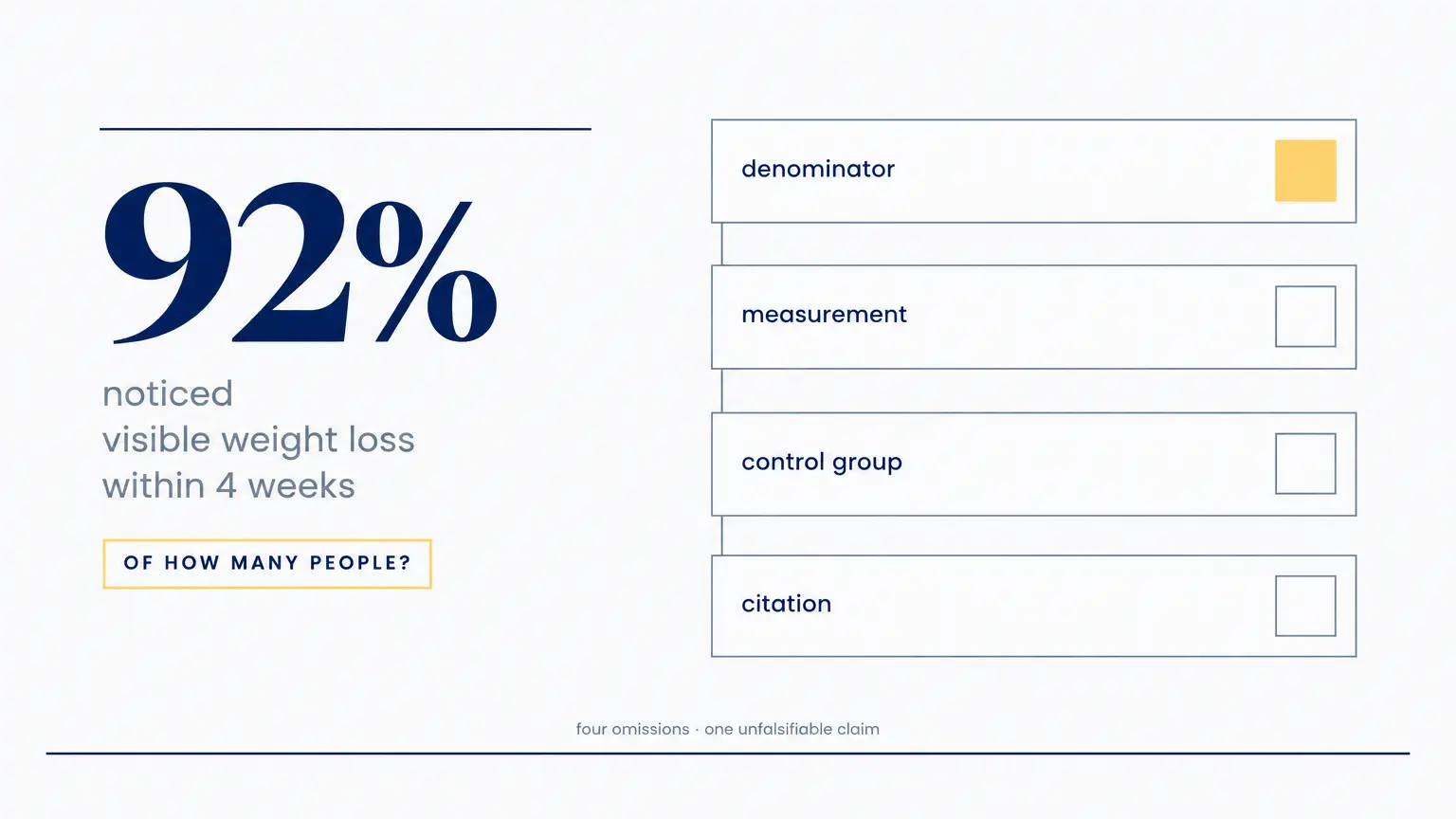
A percentage is not a finding. It is a sentence with a number in it, and what it means depends entirely on what was left out of the sentence.
What this guide argues
Weight-loss marketing does not invent statistics. It builds statements that are true and unverifiable at the same time. "92% noticed visible weight loss" can be a completely honest description of a customer survey and still tell you nothing about whether the product works.
The trick is structural, not verbal. Four things are systematically omitted: how many people were measured, what was measured and how, what happened to a comparison group, and which trial this came from. Remove any one of them and the claim cannot be checked. Remove all four and it can be published with impunity, because there is nothing to check against.
On this page
- Anatomy of the standard claim
- Mechanic one: the missing denominator
- Mechanic two: the verb that measures nothing
- Mechanic three: the absent control group
- Mechanic four: the timeline that outlasts the guarantee
- The disclaimer that contradicts the headline
- What a real weight-loss claim looks like
- The four questions
- FAQ
- Closing
Every review published on this site runs into the same obstacle. The product's label publishes doses — sometimes — but the product's page publishes something else entirely: percentages, testimonials and timelines, presented under a heading like "proven results". Those numbers are the reason most people buy. They are also the one part of the marketing that is never sourced.
This guide takes the standard claim apart. It uses the format that appears on almost every page in this category, and it explains why the format exists — not because marketers are unusually dishonest, but because the format is the only one that survives contact with a reader who might check.
Anatomy of the standard claim
Here is a typical block, taken from the pattern rather than from one brand. Three figures, each with a percentage, a verb and a timeframe:
| The claim | What is stated | What is not |
|---|---|---|
| 92% noticed visible weight loss within 4 weeks | A proportion, an outcome, a period | Sample size, measurement, control group, citation |
| 94% experienced a surge in energy within 2 weeks | A proportion, an outcome, a period | Sample size, measurement, control group, citation |
| 89% felt fewer cravings within 3 weeks | A proportion, an outcome, a period | Sample size, measurement, control group, citation |
Notice the structure. Each figure looks specific — a percentage is precise, a timeframe is precise — and the precision is doing the work that evidence would otherwise do. A reader who sees 92% does not usually ask "92% of how many?", because the number looks like it already came from somewhere rigorous.
That is the whole mechanism. Precision is not the same as rigour, and a number can be exact while the thing it describes is unknown.
Take any percentage claim and add the phrase "of the people we asked". If the sentence becomes obviously meaningless — "92% of the people we asked noticed" — the original was carrying meaning it did not have. The number described a survey, and the sentence implied a trial.
Mechanic one: the missing denominator
A percentage is a fraction with the bottom number hidden. 92% is 92 out of 100 — but out of which 100?
The denominator determines everything. The same figure means radically different things depending on what it is:
| If 92% came from… | What it actually tells you |
|---|---|
| 23 customers in a follow-up email list | Nothing. It describes who opened an email and felt positive. |
| 150 people who bought and were surveyed | A customer satisfaction figure. Not a health outcome. |
| 150 people in a trial with 150 controls | A real finding, if the measurement was objective. |
| 150 people with a control arm and blinded assessment | A publishable result that would be cited by name. |
⚠️ **The last two rows would be published in a journal and cited by name.** That is the give-away. A brand with a real controlled trial at a real dose does not display the result as an anonymous percentage under a stock-photo header — it cites the study, because the citation is the asset. When the citation is absent, it is usually not an oversight.
There is a further problem with small denominators that is worth stating plainly. In a group of 25, three people who feel good produce a figure of 88%. Round it, describe it as "nearly 9 in 10", and it reads exactly like a finding. The arithmetic of small numbers makes any survey into a statistic if you choose the sentence carefully.
Mechanic two: the verb that measures nothing
This is the most important line in the guide, and it is a question of grammar rather than statistics.
"Noticed" is not "lost".
"Felt" is not "measured".
"Experienced" is not "showed".
Noticing is a self-report. Losing is a measurement. They are different kinds of claim, and only one of them can be wrong in a way a reader could detect.
Look at the three standard claims again with the verbs emphasised: 92% noticed visible weight loss. 94% experienced a surge in energy. 89% felt fewer cravings.
Not one of them states a measurable outcome. There is no kilogram figure, no percentage of body weight, no waist circumference, no validated appetite scale. A trial that measured those things would report them, because a measured outcome is the whole point of running a trial.
The consequence is structural: **a claim about noticing cannot be contradicted.** If participants lost no weight, they may still have noticed something — a change in how their clothes felt, a change in how they felt about themselves, a change caused by the fact that they had paid money and were paying attention. Self-report surveys reliably capture the last of these.
Why this specific wording is chosen
Compare two sentences that could describe the same study:
- "92% noticed visible weight loss." — cannot be false, because "noticed" is unmeasured and unfalsifiable.
- "The treatment group lost a mean of 2.1 kg more than placebo over 12 weeks." — can be false, can be checked, can be compared to other trials.
The first sentence is not a weaker version of the second. It is a different kind of sentence, engineered to survive scrutiny by making scrutiny impossible. This is the distinction the claim-verification guide sets up in general terms; the weight-loss version is simply the purest example of it.
Research on weight management consistently finds that self-reported and measured outcomes diverge, and that participants systematically overestimate their own adherence and progress. This is not dishonesty — it is how self-perception works. It is also why every clinical trial in this field uses a scale rather than a questionnaire. When the marketing uses a questionnaire, it is measuring something the trials deliberately do not rely on.
Mechanic three: the absent control group
Suppose, for the sake of argument, that 92% of participants genuinely did notice weight loss. There is still a question that decides whether the product caused it: what would have happened to those same people without the product?
This is what a control group exists to answer, and its absence is the reason a percentage cannot establish causation even when the percentage is honestly reported.
| What happens without a control | Why it matters |
|---|---|
| Everyone in the group is taking the product | There is no comparison — the figure describes the group, not the product |
| Everyone volunteered and paid | People motivated enough to buy are already changing behaviour |
| Everyone was asked how they felt | Attention itself changes how people report their bodies |
| Weight naturally fluctuates | Some of any group will lose weight for reasons unrelated to the product |
The placebo response in weight-management research is not trivial. Trials in this field routinely show measurable change in the control arm — from dietary advice given to both groups, from the act of enrolling in a study, from seasonal variation, from the decision to pay attention to one's body. A supplement that shows an effect without a control has shown an effect that may be entirely attributable to being in a study.
⚠️ **This is the mechanic that most cleanly separates a real trial from a survey.** A trial must have a comparison; a survey cannot. When the marketing reports a proportion with no mention of a comparison group, the omission is not a stylistic choice — there was no comparison to report.
Mechanic four: the timeline that outlasts the guarantee
The timeframes in these claims are not arbitrary. They are chosen, and they are chosen to interact with the refund policy.
The standard pattern reads roughly like this: visible results in four weeks, backed by a 30-day money-back guarantee. Those two numbers sit on the same page, and read quickly they sound reassuring together. Read carefully, they cancel each other out.
| Day | What is happening | Guarantee status |
|---|---|---|
| 0 | Order placed | Window opens (if it opens at purchase) |
| 3–7 | Shipping | Window still burning |
| 7 | First sachet taken | 7 days already spent |
| 21 | Third week — cravings claim window | 9 days left |
| 28 | Fourth week — weight-loss claim window | 2 days left, at most |
| 30 | Window closes | Result is due now |
The claimed result and the refund deadline arrive at the same moment. That is not a coincidence of arithmetic; it is the design. A guarantee that expires exactly when the promised benefit is supposed to appear is a guarantee that can only be used by someone who gave up early.
⚠️ **The detail that decides it is whether the window starts at purchase or at delivery.** Read the terms. If it starts at purchase, shipping time is deducted from your testing period, and the effective window is 30 days minus however long the parcel took. The guarantee guide sets out the clauses that empty this kind of window in practice — return postage, opened-product exclusions, processing fees.
There is one more layer. If the honest test of a weight-management product requires weeks, and the guarantee covers less time than the test, then the guarantee is not a risk-reversal. It is a deadline for hope.
What a real weight-loss claim looks like
It is worth seeing the contrast, because genuine claims exist and they look nothing like the ones above. Here is the shape of a real one:
| Element | The marketing pattern | A genuine claim |
|---|---|---|
| Denominator | Absent | Stated: "in 184 adults" |
| Outcome | "Noticed", "felt" | Measured, with a number: "mean 2.1 kg" |
| Comparison | None | Placebo arm, same protocol |
| Duration | Short and flattering | Stated, often long, sometimes unflattering |
| Citation | None | Named journal, named authors, openable |
| Limitations | None | Stated in the abstract, in the paper |
The irony is that genuine claims are weaker than marketing claims. A real trial in this category typically reports a modest effect, often not statistically significant, often accompanied by the observation that the effect was smaller than the researchers hoped. Which is precisely why the marketing never cites it.
This connects directly to the "clinically studied" guide: even when a brand does cite a study, the study usually concerns an ingredient rather than the finished product, at a dose the product does not contain. The weight-loss version is the same manoeuvre with an extra layer — the study is not cited at all, only its most quotable output.
The four questions
All of the above compresses into four questions you can apply to any claim in about a minute. They are ordered, because the later ones depend on the earlier.
- How many people? If the denominator is absent, stop — the claim cannot be evaluated further. Everything downstream depends on knowing the group size.
- Measured or reported? Read the verb. "Lost", "reduced", "decreased" suggest measurement. "Noticed", "felt", "experienced" describe a survey. A survey can tell you about satisfaction and cannot tell you about physiology.
- Compared to what? If everyone took the product, there is no comparison, and the result describes a group rather than a product. Ask what the group would have experienced without it.
- Which study? If a trial is named, open it and check three things: was the dose the same as the product's, was the population similar, and did the results actually say what the marketing says. Often the third answer is no.
An unverifiable claim is not proof of fraud. It is an absence of evidence, which is a different thing. Treat the product as if no result claim had been made at all — evaluate it on the panel, the doses, the price per day and the refund terms. Those are checkable, and the cost-per-day method and the blend guide show how far that gets you without any customer figures at all.
Frequently asked questions
What does "92% noticed visible weight loss" actually mean?
It means 92% of a group whose size is not stated answered affirmatively to a question whose wording is not stated, after a period that may or may not have been controlled. Without a denominator, a question, a measurement method and a comparison group, the figure cannot be interpreted. The same sentence could describe 25 customers in a follow-up email or 400 participants in a controlled trial, and the reader has no way to tell which.
Is a customer survey a valid form of evidence?
Not for claims about physical change. A survey records what people say, not what happened. Self-reported weight loss correlates poorly with measured weight loss, and the people most likely to respond to a follow-up survey are the ones who feel the product worked. Research in this field repeatedly finds self-perception and measured outcomes diverge, which is why trials use scales and calipers rather than questionnaires.
Why do the percentages always describe "noticing" rather than losing weight?
Because noticing is unmeasurable and losing a specific number of kilograms is measurable. A claim that participants noticed something cannot be contradicted by a result, since there is no objective threshold to fail. A claim that participants lost at least 5% of body weight can be checked, compared and falsified. Marketing prefers the version that cannot be falsified.
What does the FDA allow a supplement to claim about weight loss?
Dietary supplements may not claim to treat, cure or prevent obesity or any disease. Structure-function claims — describing how an ingredient affects normal body function — are permitted with the mandatory disclaimer that the statement has not been evaluated by the FDA. A specific quantified outcome claim, such as a defined weight loss in a defined time, requires substantiation as advertising, which is enforced by the FTC rather than the FDA.
Why do these claims never cite a study?
Because citing a study invites the reader to open it. A percentage with no citation is not accountable to anything, while a citation to a real trial can be checked for sample size, dose, duration and whether the results matched the marketing. When a brand does cite research, the citation often turns out to be an ingredient study rather than a product study, at a dose the product does not contain.
What is the "not proved scientifically" disclaimer at the bottom of these pages?
It is the structure-function disclaimer required by US law for supplement marketing, and it typically states that health claims on the site have not been evaluated by the FDA. Read carefully, it directly contradicts the percentage figures and outcome claims placed above it on the same page. The seller is legally obliged to publish it, and most buyers never scroll to it.
Does the 30-day guarantee really protect me if results take four weeks?
Usually not as advertised. If the refund window opens at the date of purchase rather than delivery, and shipping takes several days, and the claimed result requires four weeks, the window and the result run out at approximately the same moment. Depending on the terms, the buyer may need to return the product before any result could plausibly appear. Check whether the window starts at purchase or delivery, and whether opened product is refundable.
Can any supplement produce clinically significant weight loss on its own?
No supplement has been shown to produce clinically significant weight loss as a single intervention. The published evidence supports, at most, small effects on secondary measures such as appetite or thermogenesis, in combination with a calorie deficit. Body weight regulation involves energy balance, hormonal signalling and behaviour, and no oral supplement changes that to a degree a person would notice as a transformation.
How can I check a weight-loss claim myself in a few minutes?
Four questions. How many people were in the group being described? Was the outcome measured or reported? What is the control group and what did it experience? And is a specific trial cited that you can open and read? If any of those four has no answer, the claim cannot be verified — which is different from being false, and also different from being true. Treat it as unverified and price the product accordingly.
Closing
The 92% is not a lie. It is a sentence built to be unfalsifiable, which is a more interesting problem than a lie. A lie can be caught. A sentence with a hidden denominator, a self-reported verb, no control group and no citation cannot be caught, because there is nothing to hold it against.
What makes this worth understanding is that it is not a quirk of one dishonest seller. It is a settled format, reproduced across hundreds of pages, because it works — on readers, and against regulators, since none of the four mechanics is itself a violation. Each omission is legal. It is the combination that produces a claim that means nothing.
The practical consequence is narrow and useful. You do not need to determine whether a product works before buying it; you need to determine what you can verify. The panel tells you what is in it. The dose comparison tells you whether that amount reaches anything studied. The cost per day tells you what you are being asked to pay for it. The guarantee terms tell you what your exit costs. None of those four depend on the percentages, and all four are checkable.
The numbers on the top of the page are the only part you cannot verify. That is not an accident, and it is a good reason to start reading at the bottom.
About this guide
BalancePhase publishes independent consumer research on supplement labelling and marketing. This guide contains no affiliate links and recommends no product. It was written and edited under the editorial direction of W. H. Neves, and the review method it supports is documented in our Methodology. Regulatory statements refer to United States law; rules differ in the EU and UK. Nothing here is medical advice — consult a clinician about weight, medication or any supplement you are considering.
Sources
- Federal Trade Commission — Dietary Supplements: An Advertising Guide for Industry, on substantiation requirements for weight-loss and health-benefit claims, including the standard that claims must be truthful, not misleading and backed by competent and reliable scientific evidence.
- U.S. Food and Drug Administration — Dietary Supplements guidance and 21 CFR 101.93, structure-function claims and the required disclaimer for dietary supplements.
- Federal Trade Commission — Gut Check: A Reference Guide for Media on Spotting False Weight-Loss Claims, on the seven weight-loss claim types that are considered false by definition, including claims of substantial weight loss without diet or exercise and claims of permanent weight loss.
- U.S. Food and Drug Administration — Weight-Loss and Deceptive Claims consumer guidance, on the characteristics of fraudulent weight-loss products and the requirement for substantiation.
- European Food Safety Authority — guidance on the scientific requirements for health claims related to appetite ratings, weight management and blood glucose, pursuant to Regulation (EC) No 1924/2006.
- Methodological literature on self-reported versus measured anthropometric outcomes in dietary intervention studies, on the systematic divergence between self-perception and measured change.
Health disclaimer
This article is for information only and is not medical advice. It does not diagnose, treat or cure any condition and is not a substitute for consultation with a qualified healthcare professional.
No dietary supplement has been shown to produce clinically significant weight loss on its own. Individual results vary. If you are considering a supplement for weight management, speak to a clinician — particularly if you take prescription medication or manage a diagnosed condition. Statements about dietary supplements have not been evaluated by the U.S. Food and Drug Administration.