Akemi Coffee Boost Review Canada: seven ingredients named, one dose published, and a 20-sachet box sold as a 30-day supply
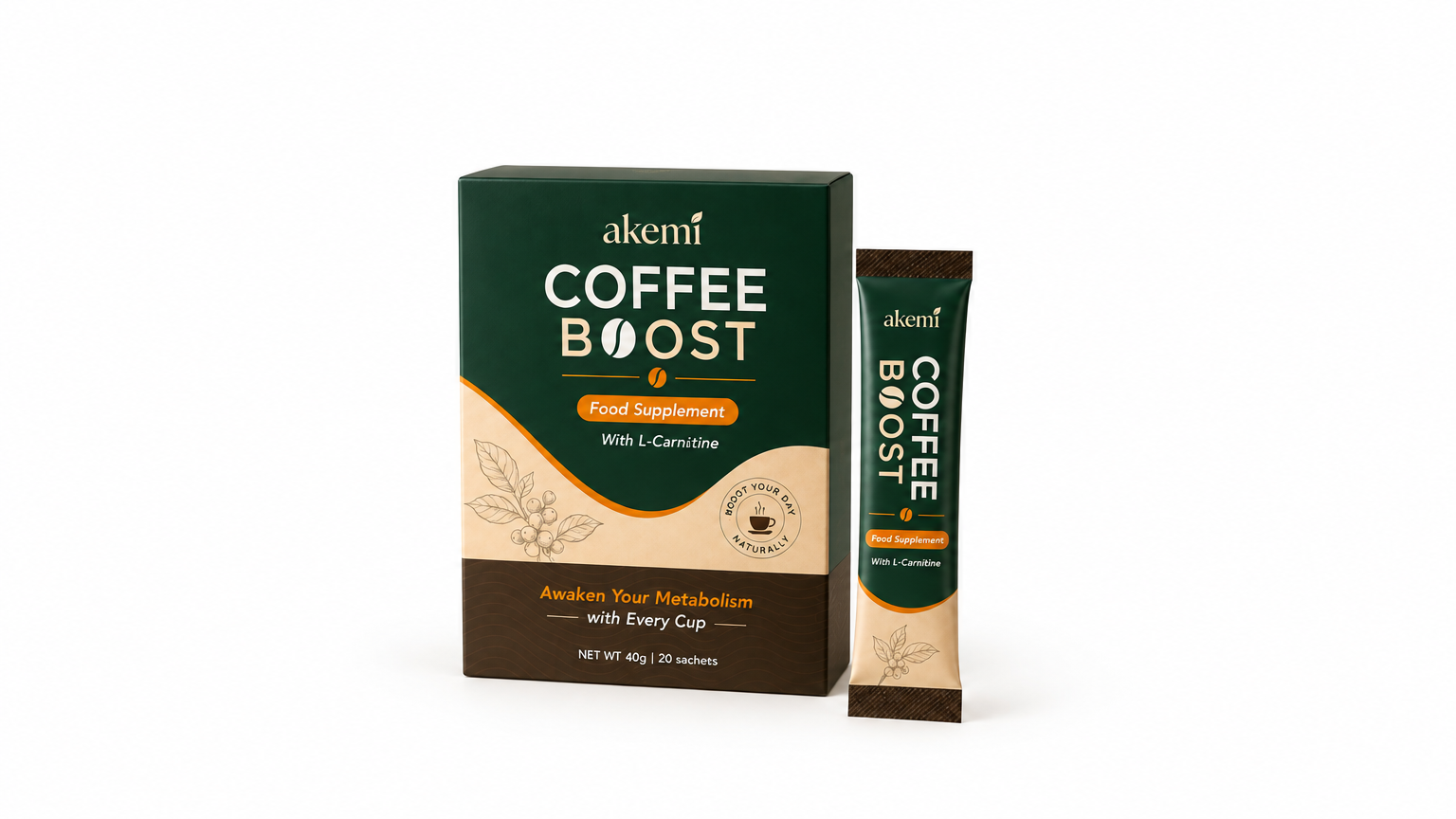
Akemi Coffee Boost — powdered food supplement, 20 sachets per box, labelled NET WT 40 g
The short answer
This is the opposite problem to a hidden blend. Seven ingredients are named on the packaging, and not one carries a published quantity. There is no proprietary blend to hide behind either — there is simply no number. Without a dose, nothing can be checked against published research, and no cost per milligram can be calculated.
Two findings follow, and both are arithmetic. The box contains 20 sachets. The checkout sells that same box as a 30-day supply and calculates every per-day figure on 30 days. At one sachet a day it lasts 20 days, so the real cost per day is 50% higher than the number on the card.
And for Canadian buyers specifically, the checkout gets halfway there. The order form correctly detects Canada — country set to Canada, a Province field instead of a State field, a Canadian flag on the phone input. But no currency code appears anywhere on the page. The three totals and the three reference prices are byte-for-byte the same as the United States, unconverted, with a bare dollar sign. Confirm what you are being charged before you order.
On this page
- What the product is
- The label: seven names, no numbers
- The caffeine question
- Twenty sachets, sold as thirty days
- Price and the real cost per day
- No currency code anywhere
- The identical reference prices
- Health Canada and the NPN question
- Importing into Canada
- Two review counts on the same site
- The testimonials
- What the guarantee covers
- Honest limits
- Who it suits, and who should skip it
- FAQ
- Verdict
What the product is
Akemi Coffee Boost is a powdered food supplement sold in sachets, one a day, stirred into coffee or water. The front of the box carries the line With L-Carnitine, the promise Awaken Your Metabolism with Every Cup, and the specification NET WT 40 g / 20 sachets. It is sold only through the brand's own checkout, not in Canadian retail.
The category matters. A coffee booster is usually built on caffeine plus green tea or green coffee extract, sometimes with a fibre for satiety. This one names those and adds white kidney bean, mulberry leaf, L-carnitine L-tartrate and resistant dextrin — seven ingredients chosen to sound as though they act on several pathways at once. Whether they do depends entirely on how much of each is in the sachet, and that is the one thing the label does not say.
The label: seven names, no numbers
Most reviews of this product repeat the same list of seven ingredients. What none of them point out is that the list is names only. There is no Supplement Facts panel with quantities anywhere in the material we reviewed — no individual amount, and no blend total either.
| Ingredient as published | Named on the label | Quantity published |
|---|---|---|
| Green tea extract | Yes | None |
| Green coffee bean extract | Yes | None |
| White kidney bean extract | Yes | None |
| Mulberry leaf extract | Yes | None |
| L-carnitine L-tartrate | Yes — highlighted on the front | None |
| Resistant dextrin | Yes | None |
| Psyllium husk | Yes | None |
A dose is what makes an ingredient claim testable. Green tea extract at 500 mg and green tea extract at 50 mg are different products: one can be compared with the trials that gave the ingredient its reputation, the other cannot. On this label there is nothing to compare. That does not make the formula dishonest — it makes it unbuyable on evidence, and it means the price cannot be broken down to a cost per milligram the way it can on a label that publishes its amounts.
Note the specificity that is present. The fifth ingredient is not listed vaguely as “L-carnitine” but as L-carnitine L-tartrate, a named salt form with a documented absorption profile. That is a credential-grade detail, and it sits beside six entries with no quantity at all. The label knows how to be precise. It chooses not to be precise about amounts.
Compare this with a proprietary blend, where at least a total weight is declared and the arithmetic can be attempted. Here even that is absent. The omission is one step further back.
The caffeine question
Two of the seven named ingredients — green tea extract and green coffee bean extract — naturally contain caffeine. The product is sold as a coffee booster, so a buyer would reasonably expect to know how much they are taking. The packaging we reviewed does not state it.
Some third-party reseller pages quote a figure of roughly 30 mg per sachet. That figure does not appear on the box, on the front panel, or anywhere in the checkout we examined. We report it as an unconfirmed third-party number, not as a manufacturer declaration.
If it is around 30 mg, that is a modest dose — roughly a third of a cup of filter coffee — and it supports a “gentle energy, no jitters” positioning honestly. If it is higher, the opposite. For anyone limiting caffeine for sleep, blood pressure, pregnancy or a medication interaction, the difference between 30 mg and 120 mg is the difference between a product they can take and one they cannot. The label does not let them decide.
Twenty sachets, sold as thirty days
This finding takes one line to state. The box says 20 sachets. The checkout calls the same box a 30-day supply and a monthly supply. One sachet a day is twenty days.
The discrepancy repeats across every package. Two boxes hold 40 sachets and are sold as a 60-day supply. Three boxes hold 60 sachets and are sold as a 90-day supply. In each case the stated supply is 50% longer than the product can deliver at one sachet per day.
| Package | Boxes | Sachets | Sold as | Actually covers |
|---|---|---|---|---|
| Starter | 1 | 20 | 30-day supply | 20 days |
| Two boxes | 2 | 40 | 60-day supply | 40 days |
| Three boxes | 3 | 60 | 90-day supply | 60 days |
Two consequences follow. A customer who buys the three-box package expecting a quarter of a year receives two months. And anyone buying a single box to test the product for a month runs out after twenty days — which matters when the refund window is also thirty days, because the supply ends before the window does.
Price and the real cost per day
Figures as displayed on the checkout in November 2026. Because the sachet count is known, the cost per day can be calculated two ways: the way the checkout does it, and the way the product actually works.
| Package | Per box | Total | Per day shown | Per day real |
|---|---|---|---|---|
| 1 box · 20 days | $29.99 | $29.99 | not shown | $1.50 |
| 2 boxes · 40 days | $24.99 | $49.98 | $0.83 | $1.25 |
| 3 boxes · 60 days | $19.99 | $59.97 | $0.67 | $1.00 |
Both sets of figures are internally consistent. The checkout divides $49.98 by 60 days to reach $0.83, and $59.97 by 90 days to reach $0.67. The right-hand column divides the same totals by the days the sachets actually cover.
The cards advertise 55%, 63% and 70% savings. The real difference in cost per day between the smallest and largest package is 50% — $1.50 down to $1.00. The 70% is calculated against a struck-through reference that is identical on all three cards. The per-day figure is the only one that lets you compare what you are actually buying.
For a direct comparison within the same category, our Slimqa Coffee Booster review covers a product that publishes all five of its doses — including 120 mg of caffeine — which makes the difference between a checkable label and this one immediately visible.
The price-per-day guide sets out the full method, including the bundle anchor and the point at which a comparison stops being possible because the doses are not published. This product reaches that point.
Current Akemi Coffee Boost pricing
Package options and guarantee terms on the official checkout.
See current pricing →No currency code anywhere
This is the finding specific to buying from Canada, and it is the one to act on before anything else.
Every figure on the page carries a bare dollar sign. There is no CAD, no USD, no currency selector, no country-based price switch. The three totals are $29.99, $49.98 and $59.97. The three reference prices are $66.64, $133.29 and $199.93.
The form localises correctly. Country is set to Canada, the address block shows a Province field rather than a State field, and the phone input carries a Canadian flag with the +1 prefix. So the seller knows the buyer is Canadian. What it does not do is state the currency: no CAD label, no currency selector, no converted figure, no note explaining which dollar is being charged. The price regime stops exactly where the address detection ends.
That gap is the point. Localising the address and localising the price are two different jobs, and this checkout does the first while leaving the second undeclared. A buyer sees “Canada”, “Province” and a Canadian flag — three signals that suggest a Canadian transaction — next to a bare “$” that could be either currency. The page creates the impression of localisation without ever stating the amount in a form that can be checked.
The arithmetic is not trivial. Charged in Canadian dollars, the three-box package is CAD $59.97, or CAD $1.00 a day. Charged in US dollars and converted by your card issuer, the same package is roughly CAD $84 at a rate near 1.40, or about CAD $1.40 a day — a premium of roughly 40% over what a US buyer pays for the identical product. Your card statement and any PayPal confirmation screen both show the currency before the charge settles. Read one of them before you confirm.
This is not unique to this seller, but it is worth naming clearly: a price displayed without a currency is not a price you can compare. The verification guide treats currency as the first check for exactly this reason.
The identical reference prices
All three cards show the same struck-through per-pack figure: $66.64. The discount arithmetic against it is accurate — $29.99 is 55% below it, $24.99 is 63% below, $19.99 is 70% below. Nothing is miscalculated.
Because the same anchor appears on all three cards and is identical to the one shown in the United States in the same currency symbol, it cannot discriminate between markets or between packages. It also frames the single box — the most expensive option per day — as a 55% saving, which reads as a bargain rather than as the worst rate on the page. Under Canada's Competition Act, ordinary price claims must be substantiated by a genuine volume of sales at the reference price. Whether $66.64 meets that test is a question only the seller can answer.
The per-day column in the previous section is unaffected by any of this: it derives only from the price you pay and the sachets in the box, both of which are printed.
Health Canada and the NPN question
Canada regulates supplements as natural health products. Before a product may be sold in Canada it needs a Natural Product Number (NPN), or a DIN-HM for homeopathic products, issued after Health Canada reviews the formula, the doses and the permitted claims. That licensing step is the central difference between the Canadian and American markets: in the US, nothing is reviewed before sale.
We found no NPN in the material we examined — not on the front panel, not on the ingredient listing, not on the checkout.
A product sold only from a foreign website, without an NPN, is not authorized for sale in Canada. That does not make it illegal for you to buy for personal use, but it does mean no Canadian regulator has looked at the formula, the doses or the claims. The label becomes the only document you have — and on this label six of the seven ingredients carry no quantity at all.
Health Canada also restricts which ingredients and dose levels may appear in a licensed product, and requires that claims be supported by evidence. A formula with no published doses cannot be assessed against those limits by anyone outside the seller.
Importing into Canada
This is where the package size stops being a pricing question and becomes a logistics one.
Personal importation of natural health products into Canada is limited, and the Canada Border Services Agency can hold, return or refuse a shipment that does not meet the requirements. Practically, that means a package can arrive late, arrive incomplete, or not arrive — and the refund window keeps running while it does.
A single box is a small parcel. A 60-day supply — three boxes, roughly 120 g of powder — is a larger personal import and the more likely candidate for inspection. Duties and taxes may also be collected on delivery, which is a cost that appears nowhere on the checkout and cannot be predicted from the page. If you are choosing the largest package because of the $1.00-a-day figure, check the current Health Canada guidance on personal imports first.
Two further practical points. A shipment held at the border may require you to supply documentation, which can add weeks. And if the 30-day guarantee runs from the order date rather than delivery, a customs delay can consume a large part of it before the product reaches you. Ask the seller, in writing, which date the window starts from.
Two review counts on the same site
The checkout card for the largest package shows 4.8 stars with a review total in the region of 3,700. The testimonial page on the same site shows 4.8 out of 5 based on 5,000 Happy Customers. Both describe the same product. The two figures differ by more than 1,200.
Neither figure links to a review platform we can inspect — no Trustpilot profile, no Google reviews, no third-party verified-purchase badge. That does not establish that the reviews are fabricated. It establishes that the number cannot be checked, and that the same site publishes two versions of it. When one source gives two answers to one question, the honest position is to use neither.
This is why BalancePhase carries no star rating for this product and why the structured data on this page includes no aggregateRating. A rating we cannot verify, printed beside a review that says we did not verify it, is the exact contradiction that turns an editorial page into an advertisement.
The testimonials
Six customer stories are displayed, each with a first name, a city, five stars and a Verified Review label. They claim weight loss of 10, 15 and 20 pounds within roughly one month. All six cities named are in the United States.
Three things are worth stating plainly:
- No verification mechanism is shown. The badge is a label on the page, not a link to a purchase record. A “verified” mark that cannot be clicked is a graphic.
- All six are five stars. Six out of six at the maximum is not what a real review distribution looks like, and the absence of any middling or negative experience is itself information.
- No typical-results disclosure appears. Under both FTC guidance in the US and the Competition Act in Canada, a testimonial describing atypical weight loss should be accompanied by a clear statement of what results are typical. None is shown.
Note also that every testimonial is American. For a Canadian buyer, that means none of the six describes an experience with cross-border shipping, customs or a Canadian return. The weight-loss claims guide sets out the four questions to apply to figures of this kind: how many people, measured how, compared with what, and cited where.
What the guarantee covers
A 30-day money-back guarantee is shown on every package, and the order page states explicitly that this is a one-time purchase with no recurring billing and no hidden fees. That is a genuinely good disclosure, and we credit it.
Whether the guarantee is usable from Canada still depends on three clauses the checkout does not state.
- Does the window start at the order or at delivery? With a cross-border shipment, this is the difference between a month of testing and a fortnight.
- Can opened product be returned? A supplement you must open to test is, by definition, opened.
- Who pays return postage from Canada? Not stated anywhere. Returning a parcel to the US from Canada can cost a meaningful fraction of the single-box price of $29.99.
The refund window is 30 days. A single box holds 20 sachets. If you buy one box to test it, the product runs out ten days before the window closes, and any customs delay eats further into it. If you buy three boxes, the window still closes while two-thirds of the supply is unopened. Either way the deadline and the supply do not line up.
The guarantee guide lists the five clauses that empty this kind of promise in practice. Ask for all three answers above in writing before you pay.
Honest limits
- No dose is published. The central limit, and everything else follows from it. Without a quantity per ingredient, no claim about effectiveness can be assessed and no cost per milligram can be calculated.
- No caffeine figure is declared. Two named ingredients contain caffeine naturally, and the label does not say how much — so a “no jitters” positioning cannot be checked.
- The supply does not match the claim. Twenty sachets per box, sold as thirty days. Every per-day figure on the checkout is built on the longer number.
- No currency code on the checkout. The figures are identical to the US ladder, unconverted, with a bare dollar sign. What you are actually charged is not stated.
- No NPN found. Nothing indicates Health Canada review of the formula, the doses or the claims.
- Nothing here replaces a diet. No dietary supplement has been shown to produce clinically significant weight loss as a single intervention.
Who it suits, and who should skip it
It may suit someone who wants a single sachet to add to an existing coffee habit, likes the format, and is comfortable buying a formula whose doses are not declared. At $1.00 a day on the largest package the convenience is real, and a flavourless powder that disappears into coffee is the product's strongest point.
Skip it if you need to know the caffeine content, if you are pregnant or nursing, if you take medication that interacts with stimulants or with psyllium, or if you are choosing between products on the basis of dose — on that last point there is nothing here to compare. Psyllium should be taken with adequate water and separated from certain medications by at least two hours.
And skip the multi-box package if a customs delay would put you past the refund window, unless you have already decided you like the product. For a first order from Canada, the single box is the lower-risk choice even though it is the worst rate per day — that is a rare case where the more expensive option is the better one.
Frequently asked questions
How many sachets are in a box?
Twenty. The packaging states NET WT 40 g / 20 sachets, and one sachet is one serving. The checkout labels the same box a 30-day supply and a monthly supply. Twenty sachets at one a day is twenty days, not thirty.
Are the prices in Canadian dollars?
Nothing on the page says so. The order form correctly detects Canada — country set to Canada, Province field, Canadian flag on the phone input — but every figure still carries a bare dollar sign and no currency code appears anywhere. Confirm the currency with the seller, or read the currency line on your card or PayPal confirmation, before ordering.
Is the Canadian price different from the US price?
No. The checkout shows $29.99, $49.98 and $59.97 — the same three totals as the United States, with the same struck-through references of $66.64, $133.29 and $199.93. Not one figure was converted.
What is the real cost per day?
One box is $29.99 for 20 days, or $1.50 a day. Two boxes are $49.98 for 40 days, or $1.25 a day. Three boxes are $59.97 for 60 days, or $1.00 a day. The checkout divides by 30 days per box instead and shows $0.83 and $0.67.
Are the ingredient doses published?
No. Seven ingredients are named and no individual quantity is published for any of them. There is no proprietary blend total either. Without a stated dose there is nothing to check against published research.
How much caffeine does it contain?
The packaging we reviewed does not declare a caffeine amount. Green tea extract and green coffee bean extract are both named and both contain caffeine naturally. Some third-party reseller pages state around 30 mg per sachet, but that figure does not appear on the box or the checkout.
Does it have a Health Canada NPN?
We found no Natural Product Number in the material reviewed. Health Canada requires an NPN or DIN-HM before a natural health product may be sold in Canada. A powdered supplement sold only from a foreign website sits outside that licensing framework.
Can I import it into Canada?
Personal importation of natural health products is limited, and the Canada Border Services Agency can hold, return or refuse a shipment. Duties and taxes may be collected on delivery. A 60-day supply is the most exposed scenario — check current Health Canada guidance before ordering a multi-box package.
Why do the review counts differ?
The checkout shows 4.8 with a review total in the region of 3,700. The testimonial page shows 4.8 based on 5,000 Happy Customers. They differ by more than 1,200, and neither links to an independent review platform.
Are the testimonials verified?
Each is labelled Verified Review, but no verification mechanism is shown and no reviewer profile is linked. Six testimonials are displayed, all five stars, all in US cities, all claiming 10 to 20 pounds within about a month. No typical-results disclosure appears.
What does the 30-day guarantee cover?
Every package lists a 30-day money-back guarantee, and the order page states there is no recurring billing or hidden fee. Three details still decide whether it is usable: whether the 30 days run from the order or delivery, whether opened product can be returned, and who pays return postage from Canada.
Does it cause weight loss?
There is no published evidence that this product does. No dietary supplement has been shown to produce clinically significant weight loss as a single intervention. Several of the named ingredients are plausible for appetite and glycaemic support at studied doses, but no doses are published here.
Current Akemi Coffee Boost pricing
Three packages, each box holding 20 sachets. Options and guarantee on the official checkout.
See current pricing →Verdict
Akemi Coffee Boost is a convenient format wrapped around a formula nobody can check, sold to Canada through a page that never says what currency it is charging in. The sachet dissolves cleanly and the coffee-booster idea is sound. The two numbers a buyer most needs — how much of each ingredient, and how much caffeine — are the two the label does not publish.
For a Canadian buyer the currency question comes first, because it changes what you pay by roughly 40% and the page will not tell you. The second is the supply: twenty sachets sold as thirty days, which makes every per-day figure on the checkout 50% lower than the truth. The third is the NPN, or the absence of one, which means no Canadian regulator has looked at the formula.
If you buy it, buy it as a coffee additive, not as a dosed supplement — and start with one box. Not because it is the best rate, but because a first cross-border order should not commit you to a 60-day supply while a customs delay runs down a 30-day refund window.
If you are choosing between coffee boosters on the basis of what is in them, this one gives you nothing to compare. That is the honest reason not to buy, and it is more useful than a star rating.
Current Akemi Coffee Boost pricing
With the 30-day guarantee, on the official checkout.
See current pricing →Sources
- Akemi Coffee Boost packaging, front panel — brand, product name, “Food Supplement”, “With L-Carnitine”, “Awaken Your Metabolism with Every Cup”, NET WT 40 g / 20 sachets.
- Akemi Coffee Boost ingredient listing as published — seven named ingredients, no quantities declared for any of them.
- Akemi Coffee Boost checkout, observed November 2026 — package prices, the $66.64 per-pack reference price, displayed savings, stated supply lengths, displayed cost per day, review count, and the one-time-purchase and guarantee disclosures.
- Akemi Coffee Boost checkout shipping form, observed November 2026 — country set to Canada, Province field, phone field showing a Canadian flag and +1 prefix, no currency code displayed.
- Akemi Coffee Boost testimonial page, observed November 2026 — six testimonials, displayed rating and “Verified Review” labelling.
- Health Canada — Natural Health Products Regulations, on the NPN and DIN-HM licensing requirement and on permitted claims.
- Canada Border Services Agency — personal importation and postal shipments, on hold, return and refusal of goods.
- Competition Bureau Canada — ordinary price claims and the substantiation of savings representations.
- U.S. Food and Drug Administration — 21 CFR 101.36, on the Supplement Facts panel and the declaration of individual ingredient quantities.
About this review
BalancePhase publishes independent product reviews. This page is an editorial assessment containing affiliate links. It was written and edited under the editorial direction of W. H. Neves, and the method is documented in our Methodology. Product details, prices and guarantee terms come from the packaging and the checkout as observed in November 2026. No laboratory testing was performed and no purchase was made for this review. Nothing here is medical advice.
Health disclaimer
This article is for information only and is not medical advice. It does not diagnose, treat or cure any condition and is not a substitute for consultation with a qualified healthcare professional.
Akemi Coffee Boost is a food supplement, not a medication. It contains green tea and green coffee bean extracts, which naturally contain caffeine, and psyllium husk, a fibre that should be taken with adequate water and separated from certain medications. If you are pregnant, nursing, under 18, taking prescription medication, or managing a diagnosed condition, speak to a clinician before use. Individual results vary, and no dietary supplement has been shown to produce clinically significant weight loss on its own.